- Главная
- Блог
- Об авторе
- Подписка на IT блог
-


- v1.1229
Оглавление:
- ⚡ 1. Simple explanation
- 🔥 2. Example: allocations
- 3. Where hidden allocations appear
- 1. Collections
- 2. Streams
- 3. String operations
- 4. Exceptions
- ⚙️ 4. Where Zero Allocation is Really Important
- 🚀 5. How Zero Allocation is Achieved
- 🧠 6. Important point about JVM
- 💣 7. Where Zero Allocation Breaks
- 📊 8. Comparison of Approaches
- 🏁 Result
Zero Allocation in Java: what it is and why it matters

Zero Allocation — is an approach to writing code in which no unnecessary objects are created in heap memory during runtime.
The main idea: fewer objects → less GC → higher stability and performance.
⚡ 1. Simple explanation
Every time an object is created in Java:
- memory is allocated in the heap
- GC must then clean it up
- pressure arises on memory and CPU
Zero allocation aims to completely avoid this in the hot path.
🔥 2. Example: allocations
❌ Bad:
String[] parts = line.split(",");
- an array is created
- strings are created
- regex works
✔️ Better:
// manual parsing through indexes
int start = 0;
for (int i = 0; i < line.length(); i++) {
    if (line.charAt(i) == ',') {
        // processing without creating objects
        start = i + 1;
    }
}
3. Where hidden allocations appear
1. Collections
List<Integer> list = new ArrayList<>();
- Integer = boxing
- each element = object
✔️ zero allocation option:
int[] arr = new int[1000];
2. Streams
list.stream().map(...).collect(...);
- pipeline objects
- lambda capture
- iterable wrappers
❌ almost never zero allocation
3. String operations
"a" + "b" + "c"
- new String objects are created
- StringBuilder inside
4. Exceptions
- creation of Exception object
- stack trace allocation
⚙️ 4. Where Zero Allocation is Really Important
🔥 Only in the hot path:
- high-load backend
- financial systems
- stream processing
- real-time systems
If the code is called rarely — zero allocation is not critical.
🚀 5. How Zero Allocation is Achieved
- use of primitive types (int, long)
- avoiding boxing (Integer, Long)
- manual work with arrays
- reusing objects (object pooling)
- avoid streams in hot path
🧠 6. Important point about JVM
Zero allocation ≠ magic.
JVM can:
- escape analysis remove object
- inline methods
- optimize temporary objects
But this is not guaranteed.
💣 7. Where Zero Allocation Breaks
- Stream API
- boxing/unboxing
- String operations
- lambda closures
- exceptions
📊 8. Comparison of Approaches
| Approach | Allocations | GC Load | Speed | Zero Allocation |
|---|---|---|---|---|
| for + int[] | ❌ minimal | 🟢 almost none | 🔥 maximum | ✔️ yes |
| List |
💣 many | 🔴 high | 🟡 average | ❌ no |
| Stream API | ⚠️ average | 🟡 average | 🟡 average | ❌ almost never |
| String concat | ⚠️ average | 🟡 average | 🟡 average | ❌ no |
🏁 Result
Zero Allocation is not about "forbidding objects at all".
It’s about controlling the hot path and minimizing GC pressure.
Main rule:
The fewer objects → the less GC → the more stable latency
Оставить комментарий
Мой канал в социальных сетях
Полезные статьи:
Series: Go for Java Developers — analyzing pointer, closures, defer, panic/recover In this article, we will analyze how Go manages the state and lifecycle of functions. A feature of Go is the ease of…
Multithreading is not just about "starting a million threads and letting them calculate". It is the art of efficiently using CPU and memory resources, safely processing data, and properly distributing…
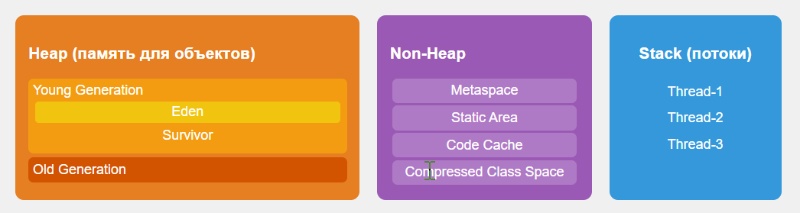
Diagram - Java Memory Model - Heap / Non-Heap / Stack Heap (memory for objects) Creates objects via new. Young Generation: Eden + Survivor. Old Generation: objects that have survived several GC c…
Новые статьи:
Concurrency is not about “starting many threads”. It’s about agreements between them. Imagine a restaurant kitchen: — cooks (threads / goroutines) — orders (tasks) — and the main question: how do th…

Imagine a typical production service. 32 CPU hundreds of threads configuration / session / rate limits cache tens of thousands of operations per second And somewhere inside — a regular Map. At first…

Zero Allocation — is an approach to writing code in which no unnecessary objects are created in heap memory during runtime. The main idea: fewer objects → less GC → higher stability and performance. …