- Главная
- Блог
- Об авторе
- Подписка на IT блог
-


- v1.1229
Оглавление:
- ⚡ 1. Simple explanation
- 🔥 2. Example: allocations
- 3. Where hidden allocations appear
- 1. Collections
- 2. Streams
- 3. String operations
- 4. Exceptions
- ⚙️ 4. Where Zero Allocation is Really Important
- 🚀 5. How Zero Allocation is Achieved
- 🧠 6. Important point about JVM
- 💣 7. Where Zero Allocation Breaks
- 📊 8. Comparison of Approaches
- 🏁 Result
Zero Allocation in Java: what it is and why it matters

Zero Allocation — is an approach to writing code in which no unnecessary objects are created in heap memory during runtime.
The main idea: fewer objects → less GC → higher stability and performance.
⚡ 1. Simple explanation
Every time an object is created in Java:
- memory is allocated in the heap
- GC must then clean it up
- pressure arises on memory and CPU
Zero allocation aims to completely avoid this in the hot path.
🔥 2. Example: allocations
❌ Bad:
String[] parts = line.split(",");
- an array is created
- strings are created
- regex works
✔️ Better:
// manual parsing through indexes
int start = 0;
for (int i = 0; i < line.length(); i++) {
    if (line.charAt(i) == ',') {
        // processing without creating objects
        start = i + 1;
    }
}
3. Where hidden allocations appear
1. Collections
List<Integer> list = new ArrayList<>();
- Integer = boxing
- each element = object
✔️ zero allocation option:
int[] arr = new int[1000];
2. Streams
list.stream().map(...).collect(...);
- pipeline objects
- lambda capture
- iterable wrappers
❌ almost never zero allocation
3. String operations
"a" + "b" + "c"
- new String objects are created
- StringBuilder inside
4. Exceptions
- creation of Exception object
- stack trace allocation
⚙️ 4. Where Zero Allocation is Really Important
🔥 Only in the hot path:
- high-load backend
- financial systems
- stream processing
- real-time systems
If the code is called rarely — zero allocation is not critical.
🚀 5. How Zero Allocation is Achieved
- use of primitive types (int, long)
- avoiding boxing (Integer, Long)
- manual work with arrays
- reusing objects (object pooling)
- avoid streams in hot path
🧠 6. Important point about JVM
Zero allocation ≠ magic.
JVM can:
- escape analysis remove object
- inline methods
- optimize temporary objects
But this is not guaranteed.
💣 7. Where Zero Allocation Breaks
- Stream API
- boxing/unboxing
- String operations
- lambda closures
- exceptions
📊 8. Comparison of Approaches
| Approach | Allocations | GC Load | Speed | Zero Allocation |
|---|---|---|---|---|
| for + int[] | ❌ minimal | 🟢 almost none | 🔥 maximum | ✔️ yes |
| List |
💣 many | 🔴 high | 🟡 average | ❌ no |
| Stream API | ⚠️ average | 🟡 average | 🟡 average | ❌ almost never |
| String concat | ⚠️ average | 🟡 average | 🟡 average | ❌ no |
🏁 Result
Zero Allocation is not about "forbidding objects at all".
It’s about controlling the hot path and minimizing GC pressure.
Main rule:
The fewer objects → the less GC → the more stable latency
Оставить комментарий
Мой канал в социальных сетях
Полезные статьи:
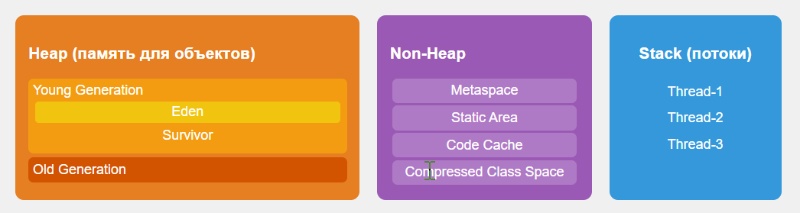
Diagram - Java Memory Model - Heap / Non-Heap / Stack Heap (memory for objects) Creates objects via new. Young Generation: Eden + Survivor. Old Generation: objects that have survived several GC c…

In modern Java development, there are three main approaches to asynchrony and concurrency: CompletableFuture — for single asynchronous tasks. Flow / Reactive Streams — for data flows with backpressur…
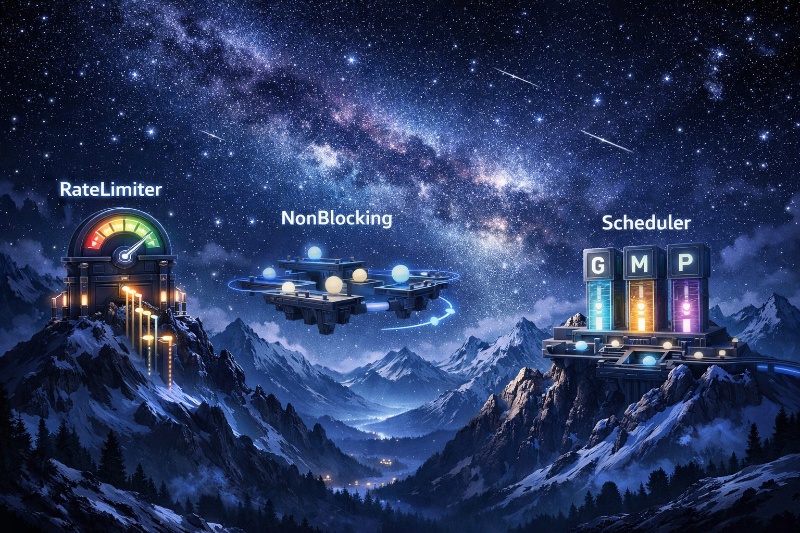
This article is dedicated to understanding the principles of working with concurrency and synchronization in Go and Java. We will look at key approaches such as rate-limiter, non-blocking operations, …
Новые статьи:
Concurrency is not about “starting many threads”. It’s about agreements between them. Imagine a restaurant kitchen: — cooks (threads / goroutines) — orders (tasks) — and the main question: how do th…

Imagine a typical production service. 32 CPU hundreds of threads configuration / session / rate limits cache tens of thousands of operations per second And somewhere inside — a regular Map. At first…

Zero Allocation — is an approach to writing code in which no unnecessary objects are created in heap memory during runtime. The main idea: fewer objects → less GC → higher stability and performance. …