- Главная
- Блог
- Об авторе
- Подписка на IT блог
-


- v1.1229
Оглавление:
- 1) Simple if / else
- 2) else if — chain of checks
- 3) Comparison Operators and Negation
- 4) Logical operators: && (AND) and || (OR)
- 5) Ternary Operator — Compact, but Cautious
- 6) switch — when there are many discrete options
- 7) A small cheat sheet for debugging
- Test — How well did you understand the lesson?
Conditional operators in Java
Java — Conditional Operators
Visual article with examples: if / else / logic / ternary operator / switch
In brief — conditional operators allow the program to make decisions: to execute one piece of code or another depending on the expression. Below are compact explanations and examples that you can copy and run in your environment.
The main idea: "if the condition is true — do one, otherwise — do the other." This is how programs become smarter.
1) Simple if / else
Check equality and output the result.
// example: simple if/else
int a = 1;
if (a == 1) {
    System.out.println("Условие выполняется: a == 1");
} else {
    System.out.println("Условие не выполняется");
}
Output when a = 1: Condition is met: a == 1
2) else if — chain of checks
When you need to check several options one after another.
int a = 2;
if (a == 1) {
    System.out.println("a == 1");
} else if (a == 2) {
    System.out.println("a == 2");
} else {
    System.out.println("none of the options");
}
Tip: the order is important — the first matching if/else if "absorbs" the execution.
3) Comparison Operators and Negation
!=— not equal>,<— greater / less>=,<=— greater/less or equal!— logical "not" for boolean expressions
int a = 3;
if (a != 2) {
    System.out.println("a не равно 2");
}
if (a > 2) {
    System.out.println("a больше 2");
}
4) Logical operators: && (AND) and || (OR)
Composite conditions.
int a = 3, b = 1;
// logical AND: both conditions must be true
if (a == 3 && b == 1) {
    System.out.println("both conditions are true");
}
// logical OR: it’s enough for at least one to be true
if (a == 2 || b == 1) {
    System.out.println("at least one is true");
}
5) Ternary Operator — Compact, but Cautious
Shortened form of if/else. Good for simple assignments, but beginners are better off reading the regular if.
int a = 3, b = 1;
int c = (b == 1) ? (a + 1) : (a - 1);
System.out.println(c);
If b == 1, then c = a + 1, otherwise c = a - 1.
6) switch — when there are many discrete options
Easy to read, especially with many integer/string cases. Don't forget break.
int a = 5;
switch (a) {
    case 1:
        System.out.println("a == 1");
        break;
    case 2:
        System.out.println("a == 2");
        break;
    case 3:
        System.out.println("a == 3");
        break;
    default:
        System.out.println("Condition not met");
}
7) A small cheat sheet for debugging
- To understand why it doesn't enter the condition — print the values of the variables before checking.
- Check types: comparison
==for references (objects) — is not the same as for primitives. - The ternary operator is good in one line — but do not make complex logic in it.
Test — How well did you understand the lesson?
Оставить комментарий
Мой канал в социальных сетях
Полезные статьи:
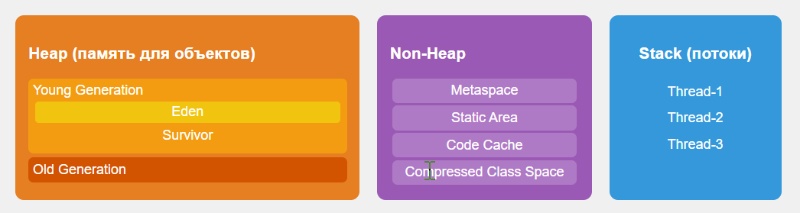
Diagram - Java Memory Model - Heap / Non-Heap / Stack Heap (memory for objects) Creates objects via new. Young Generation: Eden + Survivor. Old Generation: objects that have survived several GC c…

Memory model is a layer between the program and the processor. Modern CPUs aggressively optimize execution: instructions may be reordered, data may be stored in core caches, and operations may be perf…

In modern Java development, there are three main approaches to asynchrony and concurrency: CompletableFuture — for single asynchronous tasks. Flow / Reactive Streams — for data flows with backpressur…
Новые статьи:
Concurrency is not about “starting many threads”. It’s about agreements between them. Imagine a restaurant kitchen: — cooks (threads / goroutines) — orders (tasks) — and the main question: how do th…

Imagine a typical production service. 32 CPU hundreds of threads configuration / session / rate limits cache tens of thousands of operations per second And somewhere inside — a regular Map. At first…

Zero Allocation — is an approach to writing code in which no unnecessary objects are created in heap memory during runtime. The main idea: fewer objects → less GC → higher stability and performance. …