Analyzing: array, slice, map, zero value - in Go vs Java | Types - Language
Series: Go for Java Developers
This article opens a series of materials about the Go language for developers who are already well acquainted with Java. We will compare the approaches of the two languages to quickly understand how the Go data model is structured and why it looks the way it does.
Why break down basic structures at all
In Java, almost all collections are classes from the standard library. You create an ArrayList, HashMap, HashSet object and work with them.
In Go, everything is organized a bit differently. Many data structures are built directly into the language.
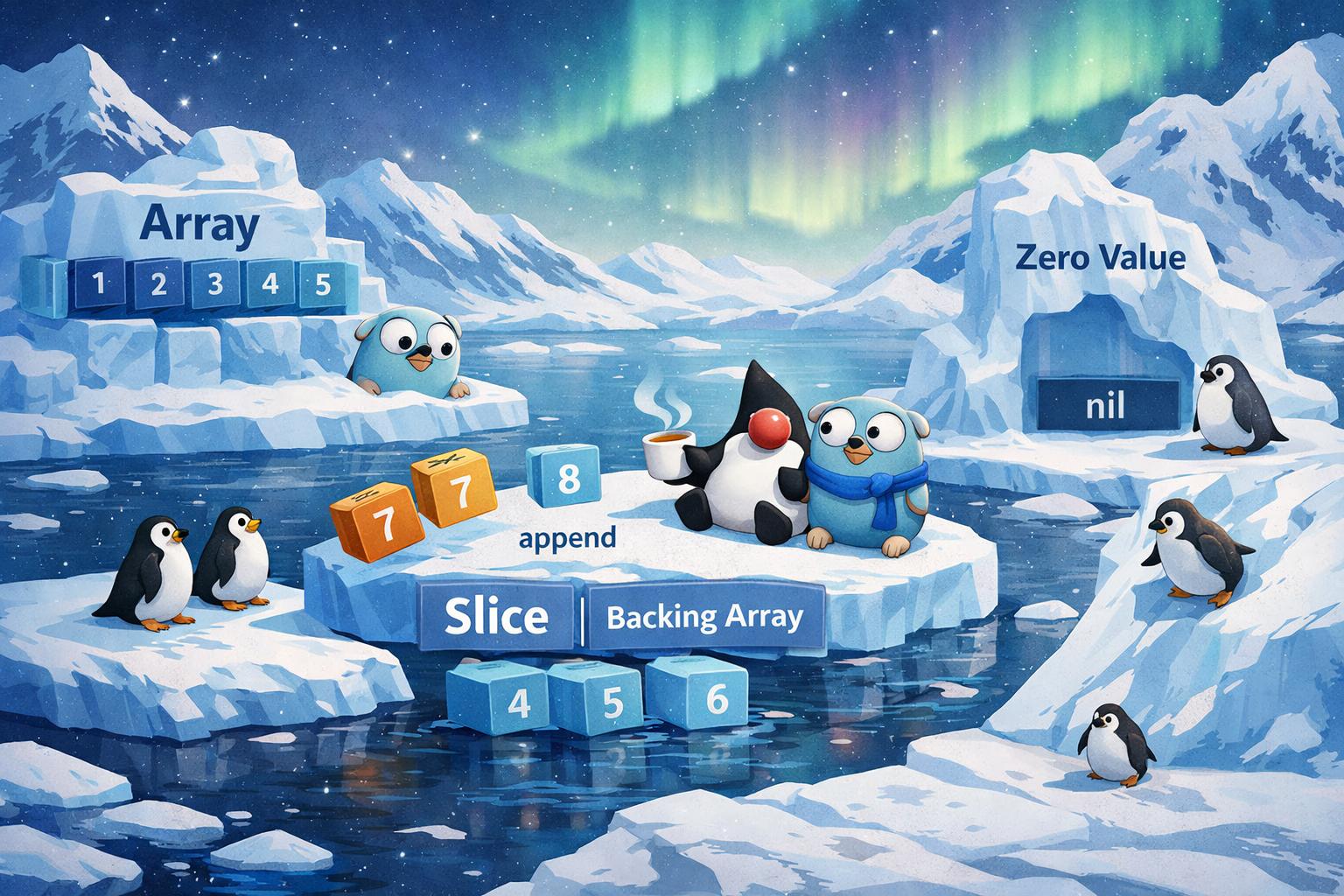
- array — fixed array
- slice — dynamic structure on top of an array
- map — hash table
- zero value — built-in default value
That is why it is important to understand how they are related to memory. Go simplifies many things, but sometimes it is less obvious for a Java developer.
Array in Go
Array in Go is a fixed-size array. The size is part of the type.
This means that [3]int and [5]int are different types.
Example
// declaring an array of 3 elements
var nums [3]int

// writing values
nums[0] = 10
nums[1] = 20
nums[2] = 30

// output
fmt.Println(nums)
Java equivalent:
// fixed-size array
int[] nums = new int[3];

nums[0] = 10;
nums[1] = 20;
nums[2] = 30;

System.out.println(Arrays.toString(nums));
At first glance — everything is the same. But in Go, arrays are used significantly less often.
In real Go code, slice is almost always used instead of array. Array is more often used as an internal mechanism for data storage.
Slice — the main container of Go
Slice is a dynamic structure, which works on top of an array.
In fact, a slice is a small descriptor, which contains three things:
- pointer to an array
- length
- capacity
Example of slice
// creating a slice
var nums []int

// adding an element
nums = append(nums, 1)

// adding more
nums = append(nums, 2, 3)

fmt.Println(nums)
Java equivalent:
// dynamic list
List<Integer> nums = new ArrayList<>();

// adding elements
nums.add(1);
nums.add(2);
nums.add(3);

System.out.println(nums);
The behavior is similar to ArrayList, but implemented differently.
Slice Backing Array
The most important concept is the backing array.
A slice holds a reference to the array, where the actual data resides.
Schematically, it looks like this:
Slice
 ├─ pointer ────────────┐
 ├─ length              │
 └─ capacity            │
                        ▼
Backing Array
[10][20][30][40][50]
If a new slice is created, it may point to the same array.
Example
// original array
arr := [5]int{1,2,3,4,5}

// creating slice
s1 := arr[1:4]

fmt.Println(s1)
Java equivalent (conditional)
// there is no direct equivalent in Java

int[] arr = {1,2,3,4,5};

// usually part of the array is copied
int[] slice = Arrays.copyOfRange(arr, 1, 4);

System.out.println(Arrays.toString(slice));
In Java, copying occurs more frequently, while in Go, memory sharing is common.
Multiple slices can reference the same backing array. Changing data through one slice will change data in all.
What happens during append
If capacity allows, new elements are added to the same array.
If there is not enough space — Go creates a new array and copies the data.
append()

Slice
  ↓
is capacity sufficient?
   │
   ├─ yes → write to the same array
   │
   └─ no → new array + copying
This is similar to the internal workings of ArrayList, which also increases the internal array.
Map in Go
Map is a built-in hash table.
It is similar to HashMap from Java, but is part of the language.
Example
// creating map
ages := make(map[string]int)

// adding values
ages["Alice"] = 30
ages["Bob"] = 25

fmt.Println(ages["Alice"])
Java equivalent:
// HashMap
Map<String, Integer> ages = new HashMap<>();

ages.put("Alice", 30);
ages.put("Bob", 25);

System.out.println(ages.get("Alice"));
Zero Value — an important feature of Go
In Go, each variable automatically receives a default value.
This is called zero value.
| Type | Zero value | Comment |
|---|---|---|
| int | 0 | numeric zero |
| string | "" | empty string |
| bool | false | boolean value |
| slice | nil | but append still works |
| map | nil | needs to be created with make |
Example of slice without initialization
// nil slice
var nums []int

// append works
nums = append(nums, 1)

fmt.Println(nums)
Java analogy
// in Java the variable will be null
List<Integer> nums = null;

// nums.add(1) will trigger NullPointerException
Zero value allows for writing less defensive code. Many structures can be used immediately after declaration.
Comparison of Go and Java
| Concept | Go | Java | Comment |
|---|---|---|---|
| Array | array | array | similar |
| Dynamic List | slice | ArrayList | slice is built into the language |
| Hash Table | map | HashMap | map is part of the language |
| Default Value | zero value | null / 0 | fewer null errors in Go |
| Memory Management | slice + backing array | internal array | similar to ArrayList |
Constants / Constants
In Go, constants are declared using const and hold immutable values. You can create single or group constants. The difference from Java is that types can be implicit and iota is supported for automatic sequence generation.
Example of a single constant
// Go
const Pi = 3.14159

func main() {
    fmt.Println(Pi)
}
Java equivalent:
// Java
class Main {
    static final double PI = 3.14159;

    public static void main(String[] args) {
        System.out.println(PI);
    }
}
Example of group constants with iota
// Go
const (
    Sunday = iota
    Monday
    Tuesday
)

func main() {
    fmt.Println(Sunday, Monday, Tuesday) // 0 1 2
}
Java equivalent through enum:
// Java
enum Day { SUNDAY, MONDAY, TUESDAY }

public class Main {
    public static void main(String[] args) {
        System.out.println(Day.SUNDAY.ordinal()); // 0
        System.out.println(Day.MONDAY.ordinal()); // 1
        System.out.println(Day.TUESDAY.ordinal()); // 2
    }
}
Tip: use iota for consecutive numeric constants. Enum in Java provides similar functionality but is more strictly typed.
Practical conclusion
For a Java developer, the most important thing is to understand one thing:
in Go, containers are not so much classes as language constructs.
The main differences:
- slice replaces most use cases of ArrayList
- map — built-in hash table
- zero value reduces the number of errors
- multiple slices can share the same memory
The most common mistake of novice Go developers is forgetting that a slice can share a backing array. This can lead to unexpected data changes.
Practical rule:
- use slice instead of array
- remember about append and capacity
- use map for associative structures
- remember that zero value is often already ready for use
When these principles become habitual, Go code starts to feel significantly easier than Java code with a lot of wrapper objects.
Оставить комментарий


Useful Articles:

New Articles: