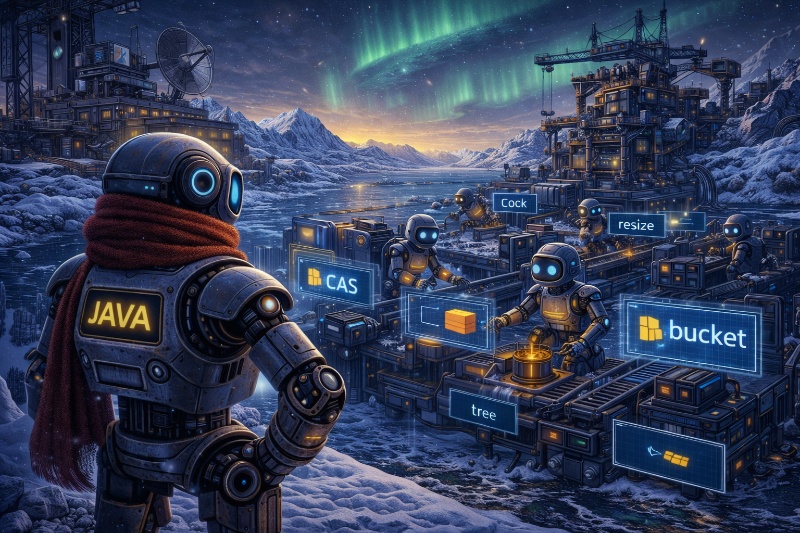
🧩 Coordination: how to synchronize chaos — Java Blocking vs Reactor vs Go
Concurrency is not about “starting many threads”. It’s about agreements between them.
Imagine a restaurant kitchen: — cooks (threads / goroutines) — orders (tasks) — and the main question: how do they coordinate?
Today you will see 3 worlds:
- 🟨 Blocking Java — “everyone waits”
- 🟣 Reactor (Reactive Streams) — “everything flows, no one blocks”
- 🔵 Go — “simple goroutines + channels”
Wait All Tasks (Barrier Join)
Wait All Tasks — 🎬 «final credits» 🍿, waiting for everyone to finish
💬 Explanation
You start several tasks — and want to continue only when all are complete.
It's like a team of builders: you can't hand over the house until everyone has finished their part.
- Java: CountDownLatch — a counter that decrements to zero
- Reactor: Mono.when — collects several async streams
- Go: WaitGroup — added tasks → waiting
🗺️ Diagram
Tasks:
 T1 ──┐
 T2 ──┼──▶ [ WAIT ALL ] ──▶ Continue
 T3 ──┘

🟨 Java:
 T1 → countDown()
 T2 → countDown()
 T3 → countDown()
 main → await()

🟣 Reactor:
 Mono1 ─┐
 Mono2 ─┼──▶ Mono.when() → done
 Mono3 ─┘

🔵 Go:
 wg.Add(3)
 go T1 → wg.Done()
 go T2 → wg.Done()
 go T3 → wg.Done()
 wg.Wait()
📊 Summary Table
| 🎯 Approach | 🟨 Blocking Java | 🟣 Reactor | 🔵 Go |
| 🧩 Example code | |
|
|
| 🧠 Mental model | Task counter. The thread is waiting. | Composition of async streams. No one is blocked. | Goroutines + counter. Simple synchronization. |
| ✔ Pros | Easy to understand. Straightforward. | Does not block the thread. Scalable. | Minimum code. Very readable. |
| ❌ Cons | Blocking → poorly scalable. | More complex thinking (reactive mindset). | Can forget Done → deadlock. |
| 💥 Model | Thread-per-task | Event-loop + non-blocking | Goroutine scheduler |
| 🛠️ Under the hood | Lock + park threads | Publisher/Subscriber + signals | Lightweight threads + runtime scheduler |
| ⚠️ Anti-patterns | Latch without countDown → hangs | Blocking inside reactive | Wait without Add or Done |
| 🚀 When to use | Small tasks | High-load async systems | Servers, concurrent tasks |
| 🔥 Comment | The "oldest" approach | The most scalable | The most intuitive |
For 🟨 Java Blocking: use CountDownLatch only for short-lived tasks — under the hood the thread is really “sleeping” and consuming resources.
For 🟣 Reactor: do not insert .block() — it breaks the entire non-blocking pipeline and turns it into blocking hell.
For 🔵 Go: always place defer wg.Done() — otherwise you'll forget and get a deadlock.
API gateway (🟣 Reactor): collect responses from several services → Mono.when → faster and non-blocking.
Batch processing (🟨 Java): started 5 tasks → waited → recorded the result — simple and clear.
Parallel workers (🔵 Go): processing a queue — WaitGroup waits for all workers to complete.
Mutex (Critical Section)
Mutex — 🔒 «one key to the door» 🚪, only one inside
💬 Explanation
When several threads want to modify the same data — control is needed.
Otherwise, there will be chaos: race condition.
Mutex = «only one goes inside».
- Java: synchronized
- Reactor: avoids shared state
- Go: sync.Mutex
🗺️ Diagram
Threads:
 T1 ─┐
 T2 ─┼──▶ [ LOCK ] → critical section → unlock
 T3 ─┘

🟨 Java:
 synchronized(obj) { ... }

🟣 Reactor:
 no lock → immutable / sequence

🔵 Go:
 mu.Lock()
 ...
 mu.Unlock()
📊 Summary Table
| 🎯 Approach | 🟨 Java | 🟣 Reactor | 🔵 Go |
| 🧩 Code Example | |
|
|
| 🧠 Mental Model | Lock object | No shared state | Explicit lock |
| ✔ Pros | Simple | No race at all | Flexibility |
| ❌ Cons | Deadlock | Hard to think | Forget unlock |
| 💥 Model | Shared memory | Message passing | Shared + channels |
| 🛠️ Under the Hood | Monitor | Event stream | Mutex + scheduler |
| ⚠️ Anti-patterns | Nested locks | Mutable state | Double lock |
| 🚀 When to Use | Legacy code | Streaming | System-level code |
| 🔥 Comment | Needed but dangerous | Better to avoid | Fine if careful |
For 🟨 Java: avoid nested synchronized — under the hood this can lead to deadlock through monitor locks.
For 🟣 Reactor: do not carry mutable state — the power of reactive is that data is not shared between threads.
For 🔵 Go: if you use a mutex — consider if it can be replaced with a channel (message passing).
Cache (🟨 Java): synchronize access to Map — otherwise race condition.
Streaming pipeline (🟣 Reactor): better to do immutable transformations — no locks needed.
Low-level services (🔵 Go): mutex for counters, metrics, shared state.
First Result Wins
First Result Wins — 🏁 «the first one gets the slippers» ⚡, we take the fastest
💬 Explanation
You launch several tasks — and take the first result.
The others — you ignore or cancel.
It's like a request to several CDNs — we take the fastest response.
- Java: CompletableFuture.anyOf
- Reactor: Flux.first
- Go: select
🗺️ Diagram
 T1 ──┐
 T2 ──┼──▶ [ FIRST ] ──▶ result
 T3 ──┘

the others are canceled / ignored
📊 Summary Table
| 🎯 Approach | 🟨 Java | 🟣 Reactor | 🔵 Go |
| 🧩 Code example | |
|
|
| 🧠 Mental model | Race futures | Race streams | Race channels |
| ✔ Pros | Fast | Very efficient | Simple |
| ❌ Cons | The others are not canceled | Complexity of debugging | Need to control leaks |
| 💥 Model | Future race | Reactive race | Select |
| 🛠️ Under the hood | CompletionStage | Signals | Scheduler + select |
| ⚠️ Anti-patterns | Ignore cancel | Hot streams | Goroutine leak |
| 🚀 When to use | Fallback API | CDN, caches | Network race |
| 🔥 Comment | Good, but be careful | Very powerful | The cleanest option |
For 🟨 Java: be sure to think about canceling the other tasks — otherwise, they continue to run and consume resources.
For 🟣 Reactor: use timeout + fallback — this strengthens the pattern.
For 🔵 Go: close channels or add context — otherwise, goroutine leaks.
Multi-CDN (all): send requests → take the fastest → reduce latency.
Failover (🟨 Java): main service + backup — anyOf.
High-load services (🟣 Reactor): race between cache and DB.
Network clients (🔵 Go): select between several data sources.
Join Futures
Join Futures — 🧺 collect a basket of results, many async tasks → one final result
💬 Explanation
Imagine a restaurant kitchen.
You ordered:
- burger
- fries
- drink
Each dish is prepared separately.
But the waiter brings one tray.
This is Join Futures.
We start several async tasks and then collect their results into one.
In different worlds, this is done differently:
- 🟨 Java Blocking — list of Future + get()
- 🟣 Reactor — flatMap + collect
- 🔵 Go — goroutines + channel
🗺️ Diagram
JOIN FUTURES

Task A ----\
              \
Task B ----- JOIN ----> final result
              /
Task C ----/


Java Blocking

Thread1 -> Task A
Thread2 -> Task B
Thread3 -> Task C

main thread:
futureA.get()
futureB.get()
futureC.get()


Java Reactive (Reactor)

Flux(tasks)
   -> flatMap(asyncCall)
   -> collectList()

does not block thread


Go

go taskA()
go taskB()
go taskC()

results <- channel

for i := 0; i < 3; i++ {
   result := <-results
}
📊 Summary Table
| What we compare | 🟨 Java Blocking approach | 🟣 Java Reactive approach | 🔵 Go |
|---|---|---|---|
| 🎯 Approach | Future + waiting for result | Reactive Streams | goroutines + channel aggregation |
| 🧩 Code example | |
|
|
| 🧠 Mental model | Each task returns a Future — a promise of a result. We collect a list and wait for each result. | We describe a data flow. flatMap creates async operations and combines them. | Each goroutine sends the result to a channel. The channel is a message queue between tasks. |
| ✔ Advantages | Easy to understand. Easy to debug. | High scalability. No thread blocking. | Very simple concurrency model. Code reads like synchronous. |
| ❌ Disadvantages | Threads get blocked. Poor scalability. | Complex mental model. Call stack disappears. | Need to manage channels. Possible goroutine leaks. |
| 💥 What model is used | Thread per task | Event loop + async pipeline | CSP model (Communicating Sequential Processes) |
| 🛠️ What happens under the hood | ThreadPool executes tasks. get() blocks the thread. | Reactor creates a non-blocking pipeline. | Go runtime schedules goroutines. |
| ⚠️ Anti-patterns | Future.get() inside a loop without pools. | Blocking inside the reactive chain. | Reading from a channel without controlling the number of messages. |
| 🚀 When to use | Small batch tasks. | High-load API. | Network services and pipelines. |
| 🔥 Comment | Blocking Java is good for simplicity. | Reactive wins with 10k+ requests. | Go provides better readability for concurrency. |
🟨 Java Blocking — never call future.get() inside a large loop without a thread pool. This turns async code back into synchronous.
🟣 Reactor — avoid .block() inside the reactive pipeline. This breaks the entire model of non-blocking execution.
🔵 Go — always control the number of reads from the channel. If you sent 5 messages — you need 5 reads.
API aggregator (Backend For Frontend) — collecting data from multiple services. Very typical Join Futures.
Search service — searching across multiple indexes.
Microservice gateway — combining responses from several downstream services.
Semaphore limit
Semaphore limit — 🚦 semaphore of tasks, limiting the number of parallel operations
💬 Explanation
Imagine a bridge.
Only 10 cars can pass at the same time.
If the 11th car arrives — it waits.
This is done by Semaphore.
🗺️ Diagram
LIMIT CONCURRENCY

Tasks -> [ LIMIT 5 ] -> execution


Java Blocking

Semaphore(5)
acquire()
run task
release()


Reactor

flatMap(task, concurrency=5)


Go

buffered channel size=5
📊 Summary Table
| What are we comparing | 🟨 Java Blocking approach | 🟣 Java Reactive approach | 🔵 Go |
|---|---|---|---|
| 🎯 Approach | Semaphore | flatMap concurrency | buffered channel |
| 🧩 Code example | |
|
|
| 🧠 Mental model | execution permissions | parallelism control in pipeline | channel as a queue of permissions |
| ✔ Pros | precise resource control | built into data stream | very simple implementation |
| ❌ Cons | may forget release() | harder to debug | can get deadlock |
| 💥 What model is used | thread synchronization | reactive backpressure | CSP concurrency |
| 🛠️ What happens under the hood | Atomic counter of permissions | Reactor scheduler controls the stream | channel blocks writing |
| ⚠️ Anti-patterns | Semaphore without finally | flatMap without concurrency limit | buffered channel without close control |
| 🚀 When to use | rate limiting | reactive API | worker pool |
| 🔥 Comment | Semaphore — the foundation of thread control | flatMap concurrency — reactive analog | Go does it in the most elegant way |
🟨 Java Blocking — always release semaphore in finally, otherwise the system will gradually hang.
🟣 Reactor — always specify concurrency in flatMap if calling external service.
🔵 Go — buffered channel is perfect as semaphore.
Database connection limiting.
External API rate limiting.
Worker pool load management.
Join Service
Join Service — 🎬 wait for all actors to finish, start task set and wait for completion
💬 Explanation
Imagine a movie.
A scene is considered complete only when all actors have finished.
That is the Join Service.
🗺️ Scheme
TASK GROUP EXECUTION

Task A
Task B
Task C

       ↓

WAIT ALL FINISH


Java

invokeAll()


Reactor

merge()


Go

WaitGroup
📊 Summary Table
| What are we comparing | 🟨 Java Blocking approach | 🟣 Java Reactive approach | 🔵 Go |
|---|---|---|---|
| 🎯 Approach | invokeAll | merge | WaitGroup |
| 🧩 Example code | |
|
|
| 🧠 Mental model | task group | stream merging | active task counter |
| ✔ Pros | very simple API | naturally fits into pipeline | minimal overhead |
| ❌ Cons | blocking | difficult diagnostics | need to manage wg.Add() carefully |
| 💥 What model is used | thread pool coordination | event stream merge | goroutine synchronization |
| 🛠️ What happens under the hood | pool waits for task completion | reactor orchestrates events | WaitGroup — atomic counter |
| ⚠️ Anti-patterns | invokeAll for long running tasks | merge without backpressure control | wg.Add after starting goroutine |
| 🚀 When to use | batch processing | event pipelines | parallel workers |
| 🔥 Comment | invokeAll — an old but reliable tool | merge — reactive orchestration | WaitGroup — one of the most beautiful primitives in Go |
🟨 Java Blocking — invokeAll is great for batch tasks.
🟣 Reactor — merge is useful for combining service streams.
🔵 Go — WaitGroup is the simplest way to synchronize goroutines.
Fan-out / Fan-in architecture.
Parallel microservice calls.
Batch data processing.
Thread coordination
Thread coordination — 🔔 a call between threads, one thread waits for a signal from another
💬 Explanation
Imagine a restaurant kitchen.
One chef is preparing a steak. Another one is preparing a side dish.
But the side dish can only be started after the signal.
The chef shouts:
“Ready!”
And the second chef starts working.
This is Thread coordination.
Threads wait for each other's signals.
In different worlds:
- 🟨 Java — wait / notify
- 🟣 Reactor — signal
- 🔵 Go — channel
🗺️ Diagram
THREAD COORDINATION

Thread A ---- work ---- notify ---->
                                   Thread B resumes


Java Blocking

Thread B
  wait()

Thread A
  notify()


Reactive

Publisher -> signal -> Subscriber


Go

goroutine A -> channel -> goroutine B
📊 Summary Table
| What we are comparing | 🟨 Java Blocking approach | 🟣 Java Reactive approach | 🔵 Go |
|---|---|---|---|
| 🎯 Approach | wait / notify | signal / reactive stream event | channel sync |
| 🧩 Example code | |
|
|
| 🧠 Mental model | A thread can sleep and wait for a signal. Another thread wakes it up via notify(). | In the reactive world, a signal is an event in the stream. | A channel is a message pipe between goroutines. |
| ✔ Advantages | Very low level of control. | No blocking. | Very clean signals model. |
| ❌ Disadvantages | Easy to get a deadlock. | Hard to understand the flow of events. | Can accidentally block the channel. |
| 💥 What model is used | monitor synchronization | event driven architecture | CSP messaging |
| 🛠️ What happens "under the hood" | The JVM puts the thread into a WAITING state. | The Reactor propagates the event through the pipeline. | The Go runtime parks the goroutine. |
| ⚠️ Anti-patterns | wait() without a while loop. | blocking calls inside a reactive chain. | a channel without a reading side. |
| 🚀 When to use | low-level concurrency libraries. | event processing pipeline. | between goroutines. |
| 🔥 Comment | wait/notify — a very powerful but dangerous tool. | reactive events replace manual signals. | Go channels make coordination natural. |
🟨 Java Blocking — always use wait() inside a while. This protects against false awakenings from the JVM.
🟣 Reactor — think of events as signals between parts of the pipeline.
🔵 Go — never send to a channel if no one is reading.
Producer-consumer pipeline — one thread produces data, another waits for a readiness signal.
Event-driven systems — react to events instead of polling.
Synchronization of data processing stages.
Race control
Race control — 🏁 one finish corridor, access control to data
💬 Explanation
Imagine an ATM.
Only one person can approach it.
If two try to do so at the same time — chaos will ensue.
This is called a race condition.
That's why access control is needed.
In different worlds:
- 🟨 Java — synchronized
- 🟣 Reactor — concatMap (guarantees order)
- 🔵 Go — mutex
🗺️ Diagram
RACE CONTROL

Task A \
        -> critical section
Task B /

only one allowed


Java

synchronized block


Reactive

concatMap -> sequential processing


Go

mutex lock
📊 Summary Table
| What we compare | 🟨 Java Blocking Approach | 🟣 Java Reactive Approach | 🔵 Go |
|---|---|---|---|
| 🎯 Approach | synchronized | concatMap | mutex |
| 🧩 Example code | |
|
|
| 🧠 Mental Model | object monitor | task queue | access lock |
| ✔ Pros | simple synchronization | guarantees event order | very fast mutex |
| ❌ Cons | blocks thread | limits parallelism | can forget Unlock() |
| 💥 What model is used | monitor lock | sequential stream | mutual exclusion |
| 🛠️ What happens "under the hood" | JVM uses monitor lock | Reactor executes tasks sequentially | Go runtime uses spinlock + park |
| ⚠️ Anti-patterns | synchronizing a large block of code | concatMap for heavy CPU tasks | mutex around slow operations |
| 🚀 When to use | shared state | event ordering | shared memory protection |
| 🔥 Comment | synchronized — the foundation of Java concurrency | concatMap — elegant order control | mutex in Go is incredibly fast |
🟨 Java Blocking — keep synchronized blocks as short as possible.
🟣 Reactor — concatMap is useful when the order of events is important.
🔵 Go — use defer mutex.Unlock() to avoid forgotten unlocks.
Updating shared cache.
Sequential processing of financial operations.
Event queues.
Fork-Join
Fork-Join — 🌳 split the task tree, solve branches in parallel and collect the result
💬 Explanation
Imagine a huge task.
For example — to sum millions of numbers.
One thread will take a very long time.
Therefore, we:
- split the task
- solve parts in parallel
- combine the result
This is Fork-Join.
🗺️ Diagram
FORK JOIN

        task
       /   \
    task   task
    / \     / \
   a  b    c   d

join results
📊 Summary table
| What we compare | 🟨 Java Blocking approach | 🟣 Java Reactive approach | 🔵 Go |
|---|---|---|---|
| 🎯 Approach | ForkJoinPool | parallel Flux | worker pool |
| 🧩 Example code | |
|
|
| 🧠 Mental model | divide and conquer | parallel stream pipeline | worker pool |
| ✔ Pros | efficient CPU usage | built-in parallelism | very flexible worker pool |
| ❌ Cons | hard to control | hard to debug | manual management |
| 💥 What model is used | work stealing | reactive parallel scheduler | goroutine worker pool |
| 🛠️ What happens "under the hood" | ForkJoinPool steals tasks between threads | Reactor distributes tasks over the scheduler | goroutines are scheduled at runtime |
| ⚠️ Anti-patterns | blocking operations inside forkjoin | parallel Flux for IO | too many workers |
| 🚀 When to use | CPU heavy tasks | data pipelines | distributed jobs |
| 🔥 Comment | ForkJoin — the heart of parallel streams | Reactor makes parallelism declarative | worker pool — classic Go approach |
🟨 Java Blocking — ForkJoinPool is perfect for CPU-heavy tasks.
🟣 Reactor — use parallel() only for CPU tasks, not IO.
🔵 Go — better to limit the worker pool to the number of CPUs.
Big data processing.
Parallel computation.
Distributed batch processing.
Ordered join
Ordered join — 📦 collect packages by number, parallel tasks → results in the original order
💬 Explanation
Imagine a delivery pipeline.
Five couriers deliver packages simultaneously. But the customer must receive them in the correct order.
Even if package №3 arrives before №2 — it needs to be waited for.
This is Ordered Join.
We run tasks in parallel, but collect the result in the original order.
In different technologies:
- 🟨 Java — list of Future
- 🟣 Reactor — concat
- 🔵 Go — ordered channel
🗺️ Diagram
ORDERED JOIN

Tasks executed in parallel:

Task1 ----\
Task2 -----\
Task3 -------> execution
Task4 -----/
Task5 ----/

BUT results must be returned in order

Result1
Result2
Result3
Result4
Result5


Java Blocking

Future1.get()
Future2.get()
Future3.get()


Reactive

Flux.concat()

ensures order


Go

channel with ordered aggregation
📊 Summary Table
| What we compare | 🟨 Java Blocking approach | 🟣 Java Reactive approach | 🔵 Go |
|---|---|---|---|
| 🎯 Approach | List<Future> | concat | ordered channel |
| 🧩 Code example | |
|
|
| 🧠 Mental model | The list of Future acts as a queue of results. We read them in the original order of tasks. | concat connects data streams sequentially, preserving the order of events. | The channel serves as a buffer for messages between goroutines. |
| ✔ Pros of this implementation | A very simple way to maintain the order of results. | Completely non-blocking data processing. | Flexibility in controlling the order of messages. |
| ❌ Cons | get() blocks the thread. | concat reduces parallelism. | you need to control the order manually. |
| 💥 What model is used | thread coordination | reactive sequencing | message passing |
| 🛠️ What happens "under the hood" | ThreadPool executes tasks in parallel. Future holds the result. | Reactor builds a pipeline for event processing. | Go runtime schedules goroutines and channels. |
| ⚠️ Anti-patterns | Future.get() inside a heavy loop. | concat for long IO operations. | reading from the channel without controlling the number of messages. |
| 🚀 When to use | batch tasks. | reactive pipelines. | stream processing. |
| 🔥 Your comment | Ordered join — important for deterministic systems. | concat — the simplest way to guarantee order. | Go offers flexibility but requires caution. |
🟨 Java Blocking — the list of Future automatically preserves the order of tasks, so it's safe to use invokeAll.
🟣 Reactor — concat ensures strict order of events but reduces pipeline parallelism.
🔵 Go — for ordering results, it's better to use indexed structures.
Aggregation API — needs to return service data strictly in the same order.
Streaming pipelines — processing events in a fixed sequence.
Batch ETL — processing files where order is important.
Barrier sync
Barrier sync — 🚧 common start line, all threads wait for each other
💬 Explanation
Imagine a marathon.
Runners must start simultaneously.
Even if someone arrives earlier — they wait for the others.
When everyone is ready — start.
This is Barrier Sync.
🗺️ Diagram
BARRIER SYNC

Thread A ----\
Thread B ----- WAIT -----> continue together
Thread C ----/


Java

CyclicBarrier.await()


Reactive

zip()


Go

WaitGroup
📊 Summary Table
| What are we comparing | 🟨 Java Blocking Approach | 🟣 Java Reactive Approach | 🔵 Go |
|---|---|---|---|
| 🎯 Approach | CyclicBarrier | zip | WaitGroup |
| 🧩 Code Example | |
|
|
| 🧠 Mental Model | thread synchronization point | waiting for all data streams | active tasks counter |
| ✔ Pros of this implementation | exact synchronization | natural for stream processing | very simple API |
| ❌ Cons | can cause deadlock | waiting for a slow source | need to control Add() |
| 💥 What model is used | thread barrier | event synchronization | task counter |
| 🛠️ What happens "under the hood" | barrier blocks threads | zip waits for elements from all streams | WaitGroup uses atomic counter |
| ⚠️ Anti-patterns | incorrect number of participants | zip for infinite streams | wg.Add after goroutine starts |
| 🚀 When to use | parallel algorithms | aggregation pipelines | task orchestration |
| 🔥 Your comment | Barrier — foundation of synchronization | zip — elegant reactive synchronization | WaitGroup — one of the best ideas in Go |
🟨 Java Blocking — CyclicBarrier is useful in parallel algorithms.
🟣 Reactor — zip is great for combining results from services.
🔵 Go — always call wg.Add() before starting goroutines.
Microservice orchestration — waiting for responses from multiple services.
Parallel computation — synchronization of algorithm stages.
Distributed pipelines — coordination of workers.
Conditional wait
Conditional wait — 🎣 wait for an event based on a condition, the thread wakes up only when the condition is met
💬 Explanation
Many beginners do this:
sleep(1 second) → check condition → sleep again.
This is called polling.
Much better — wait for an event reactively.
That is, the thread wakes up only when the condition is met.
This is called Conditional Wait.
🗺️ Diagram
CONDITIONAL WAIT

condition false -> wait

condition true -> resume


Java

Condition.await()


Reactive

filter + retry


Go

select
📊 Summary table
| What we compare | 🟨 Java Blocking approach | 🟣 Java Reactive approach | 🔵 Go |
|---|---|---|---|
| 🎯 Approach | Condition | filter + retry | select |
| 🧩 Code example | |
|
|
| 🧠 Mental model | waiting for a signal | reaction to the event stream | waiting for one of the events |
| ✔ Pros of this implementation | precise control of synchronization | ideal for event-driven systems | very flexible mechanism |
| ❌ Cons | difficult to use correctly | hard to debug the pipeline | select can complicate the code |
| 💥 What model is used | condition variable | event filtering | event multiplexing |
| 🛠️ What happens "under the hood" | the thread enters WAITING state | Reactor filters the event stream | Go runtime waits for channel events |
| ⚠️ Anti-patterns | sleep polling | blocking operations in the pipeline | select without default |
| 🚀 When to use | thread coordination | event processing | network servers |
| 🔥 Your comment | Condition — an advanced alternative to wait/notify | Reactive pipelines are perfect for conditions | select — one of the most powerful tools in Go |
🟨 Java Blocking — Condition is safer than wait/notify and provides more precise control.
🟣 Reactor — filter + retry allows waiting for an event without blocking.
🔵 Go — select is perfect for network servers.
Event-driven systems.
Network servers.
Reactive data processing pipelines.
RW lock
RW lock — 📚 reading room of the library, many readers but only one writer
💬 Explanation
Imagine a library.
Dozens of people can read a book simultaneously.
But only one person can edit the book.
This is an optimization of access:
- many readers
- one writer
This is called Read-Write Lock.
In Java, there is a special class:
ReentrantReadWriteLock
In Go, there is an analog:
sync.RWMutex
The reactive world usually avoids shared state, so there is no separate analog.
🗺️ Diagram
READ WRITE LOCK

Readers:
R1
R2
R3
R4

all allowed simultaneously

Writer:

W1

exclusive access


Java

readLock() / writeLock()


Reactive

avoid shared state


Go

RWMutex.RLock()
RWMutex.Lock()
📊 Summary Table
| What we compare | 🟨 Java Blocking approach | 🟣 Java Reactive approach | 🔵 Go |
|---|---|---|---|
| 🎯 Approach | ReentrantReadWriteLock | usually avoids shared state | RWMutex |
| 🧩 Code example | |
|
|
| 🧠 Mental model | Shared data with optimized access. | State is avoided, data flow is immutable. | Read lock allows multiple readers. |
| ✔ Pros of this implementation | High performance under read-heavy load. | No blocking. | Very light lock. |
| ❌ Cons | More complex than synchronized. | Not suitable for shared mutable state. | Can accidentally block the writer. |
| 💥 Which model is used | read-write synchronization | stateless stream | mutex coordination |
| 🛠️ What happens "under the hood" | JVM manages the queue of readers/writers. | Reactor uses immutable data. | RWMutex uses atomic operations. |
| ⚠️ Anti-patterns | using RWLock under write-heavy load. | shared mutable state in reactive pipeline. | long operations inside the lock. |
| 🚀 When to use | caches and read-heavy structures. | data pipelines. | high-performance services. |
| 🔥 Your comment | RWLock is one of the best optimizations for concurrency. | Reactive solves the problem architecturally. | Go RWMutex is incredibly efficient. |
🟨 Java Blocking — RWLock is perfect for read-heavy workloads (e.g. caches).
🟣 Reactive — it's better to completely avoid shared mutable state.
🔵 Go — RWMutex is faster than regular Mutex with a large number of readers.
In-memory cache.
Configuration storage.
Read-heavy microservices.
Phaser sync
Phaser sync — 🏗️ construction in stages, participants synchronize at each phase
💬 Explanation
Imagine building a house.
There are stages:
- foundation
- walls
- roof
You cannot build the roof until the walls are finished.
Phaser is a barrier for multiple phases of execution.
🗺️ Scheme
PHASER

Phase 1 -> barrier
Phase 2 -> barrier
Phase 3 -> barrier
📊 Summary Table
| What we compare | 🟨 Java Blocking Approach | 🟣 Java Reactive Approach | 🔵 Go |
|---|---|---|---|
| 🎯 Approach | Phaser | usually orchestrated pipeline | custom sync |
| 🧩 Code example | |
|
|
| 🧠 Mental Model | many synchronization stages | pipeline stages | manual coordination |
| ✔ Advantages of this implementation | flexible synchronization | declarative pipeline | full control |
| ❌ Disadvantages | complex API | no direct analogue | must write it yourself |
| 💥 What model is used | phase barrier | stream stage pipeline | custom coordination |
| 🛠️ What happens "under the hood" | Phaser counts participants of each phase. | Reactor executes the pipeline stage by stage. | goroutines synchronize through channels. |
| ⚠️ Anti-patterns | overly complex phaser structures. | blocking calls. | overengineering. |
| 🚀 When to use | multi-stage algorithms. | data pipelines. | complex orchestration. |
| 🔥 Your comment | Phaser is powerful but rarely used tool. | Reactive pipelines often replace phaser. | Go usually makes this easier. |
🟨 Java Blocking — Phaser is better than CyclicBarrier when there are more than one phase.
🟣 Reactive — pipeline stages naturally replace phaser.
🔵 Go — sometimes it's easier to use multiple WaitGroups.
Game engines.
Simulation systems.
multi-phase algorithms.
Latch reuse
Latch reuse — 🔄 many starts of the race, synchronization is used over and over again
💬 Explanation
CountDownLatch is a one-time barrier.
When the counter reaches zero — that's it.
It cannot be used again.
Therefore, for reuse, you need to:
- create a new latch
- recreate the pipeline
- reset the channel
🗺️ Diagram
LATCH REUSE

Round 1 -> latch
Round 2 -> new latch
Round 3 -> new latch
📊 Summary Table
| What we compare | 🟨 Java Blocking approach | 🟣 Java Reactive approach | 🔵 Go |
|---|---|---|---|
| 🎯 Approach | CountDownLatch | recreate pipeline | reset channel |
| 🧩 Example code | |
|
|
| 🧠 Mental model | one-time barrier | one-time pipeline | one-time channel |
| ✔ Pros of this implementation | very simple mechanism | native event flow | minimal code |
| ❌ Cons | cannot be reused | pipeline needs to be recreated | channel needs to be recreated |
| 💥 What model is used | countdown barrier | reactive flow | channel signal |
| 🛠️ What happens "under the hood" | Atomic counter decreases to zero. | Reactive pipeline completes the stream. | the channel sends a completion signal. |
| ⚠️ Anti-patterns | waiting for latch inside a thread pool. | blocking the reactive pipeline. | channel leaks. |
| 🚀 When to use | test orchestration. | async pipelines. | signal completion. |
| 🔥 Comment from you | Latch is a very simple but powerful tool. | Reactive pipeline usually replaces latch. | Go channels are great for signals. |
🟨 Java Blocking — CountDownLatch is good for one-time synchronization.
🟣 Reactive — pipeline is recreated for each data stream.
🔵 Go — channel often serves as a completion signal.
Integration tests orchestration.
Batch processing.
Signal completion workflows.
OUTPUT
All three worlds solve one problem:
the coordination of parallel tasks.
But they do it differently.
- 🟨 Java Blocking — a rich set of synchronization primitives
- 🟣 Reactive Java — avoids shared state and uses pipelines
- 🔵 Go — minimalism: mutex + channels
A simple selection rule:
- Shared state and high concurrency → RWLock
- Many stages of the algorithm → Phaser
- Waiting for a group of tasks → Latch
Senior level is not knowledge of the API.
It is understanding how tasks are coordinated.
Оставить комментарий


Useful Articles:

New Articles: