💻 Programming and Technology Blog:
🧩 Coordination: how to synchronize chaos — Java Blocking vs Reactor vs Go
Concurrency is not about “starting many threads”. It’s about agreements between them. Imagine a restaurant kitchen: — cooks (threads / goroutines) — orders (tasks) — and the main question: how do they coordinate? Today you will see 3 worlds: 🟨 Blocking Java — “everyone waits” 🟣 Reactor (Reac...
When HashMap starts killing production: the engineering story of ConcurrentHashMap
Imagine a typical production service. 32 CPU hundreds of threads configuration / session / rate limits cache tens of thousands of operations per second And somewhere inside — a regular Map. At first, everything looks harmless. Map<String, Session> sessions = new HashMap<>(); Then a cou...
Zero Allocation in Java: what it is and why it matters
Zero Allocation — is an approach to writing code in which no unnecessary objects are created in heap memory during runtime. The main idea: fewer objects → less GC → higher stability and performance. ⚡ 1. Simple explanation Every time an object is created in Java: memory is allocated in the heap ...

Stream vs For in Java: how to write the fastest code possible
In Java, performance is often determined not by the "beauty of the code," but by how it interacts with memory, the JIT compiler, and CPU cache. Let s analyze why the usual for is often faster than Stream, and how to write truly fast code. 1. Basic truth: Stream vs For — this is not an equal battle ...

Compiler, Build, and Tooling in Go and Java: how assembly, initialization, analysis, and diagnostics are organized in two ecosystems
This article is dedicated to a general overview of how the compiler, build, and tooling practices are arranged in Go, and how to better understand them through comparison with Java. We will not delve into the specialized details of each individual command or the internal workings of the compiler, bu...

Low-level mechanisms - part 2 | Go ↔ Java
In this article, we gathered the key low-level mechanisms of Go that most often raise questions for developers coming from Java. We will consider: unsafe.Pointer, struct alignment, pointer arithmetic, zero-copy, iota, the internals of interfaces, runtime.SetFinalizer, and runtime.KeepAlive. We wil...

Go ↔ Java: Complete Guide to Runtime, Memory, and Allocator - Part 3
This article is a comprehensive guide to the key aspects of memory and runtime work in Go and Java. We will discuss fundamental concepts: execution scheduler, memory barriers, memory alignment, stack growth, fragmentation, allocation hot spots, and the internal architecture of the Go allocator. Th...

Low-level mechanisms | Go ↔ Java
In this article, we will examine the key low-level mechanisms of Go, comparing them to similar tools in Java. The article is intended for Java developers who want to gain a deeper understanding of Go, as well as for Go developers, who wish to see how their familiar mechanisms are structured in Java....

Scheduler internals in Go ↔ Java: how your code is actually executed
When you write go func() or create a Thread in Java, it seems like you are managing concurrency. But in reality, you are passing the task to the scheduler. And this is where the real show begins. Go and Java use fundamentally different models: Go — M:N scheduler (many goroutines on fewer threads),...
Slice internals in Go ↔ Java: from header to hidden allocations
Slice in Go is one of those structures that looks simple, but under the hood behaves like a little clever beast. If you are a Java developer, you might think: "well, this is just an ArrayList." And this is where the magic begins — it’s not quite so. In this article, we will discuss: how the slice ...

Map internals from random order to bucket evacuation | Go ↔ Java
In this article, we will examine the internal structure of maps / hash tables in Go and Java. If you are a Java developer used to HashMap, you will be interested in how differently Go thinks. If you are a gopher — you will see why such compromises are made in Java. We will cover key aspects: random ...

Internal structure of the Garbage Collector: Go ↔ Java
In this article, we will thoroughly examine the work of the garbage collector (Garbage Collector, GC) in Go and Java, discuss key internal mechanisms: concurrent mark & sweep, mutator vs collector, tricolor marking, GC pacing, root set scanning, and stack scanning. For Java developers, this will...

Memory, Runtime, and Allocator: A Comparison of Go and Java for Developers
In this article, we will examine the key aspects of memory management, runtime, and object allocation mechanisms in Go and Java. We will focus on the differences in approaches to memory management, working with the stack and heap, and how these mechanisms affect performance, safety, and ease of deve...
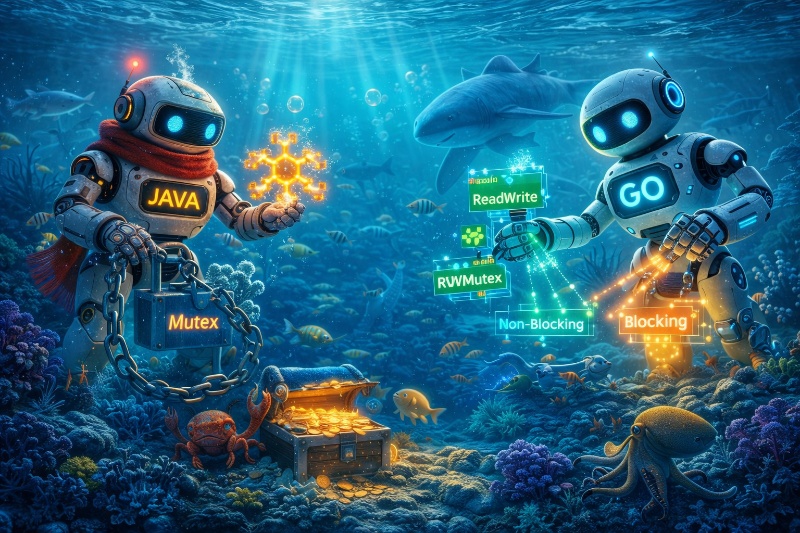
Atomic vs Mutex, Blocking vs Non-Blocking, Read/Write Splitting (RWMutex), Logging | Concurrency Patterns and Best Practices part 5 | Go ↔ Java
In this article, we will analyze the key approaches to working with parallelism and synchronization in Go and Java. We will compare how the same tasks are solved in these languages, show idioms, patterns, and best practices. The material will be useful for both Java developers learning Go and Go dev...

Resource cleanup, rate-limiting strategies, bounded vs unbounded channels - in Go vs Java | Patterns, idioms, and best practices for Go
We continue the series of articles for developers who want to learn Go based on knowledge of Java, and vice versa. In this article, we will discuss three key topics: Resource Cleanup (resource release), Rate-Limiting Strategies (load limiting strategies) and Bounded vs Unbounded Channels (bounded an...
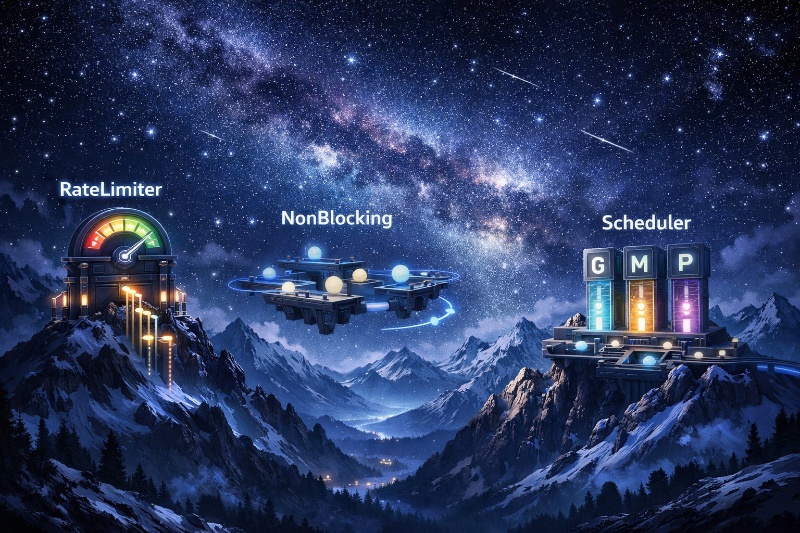
Breaking down: Rate-limiter, non-blocking operations, scheduler Go vs Java | Concurrency part 4
This article is dedicated to understanding the principles of working with concurrency and synchronization in Go and Java. We will look at key approaches such as rate-limiter, non-blocking operations, and task scheduling, compare their implementation and philosophy in both languages. This will help a...
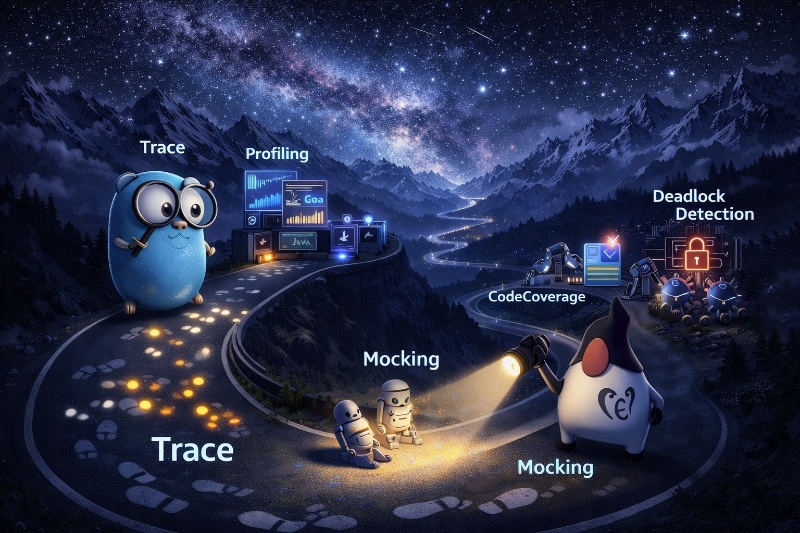
Let's look at: Trace, Profiling, Integration Testing, Code Coverage, Mocking, Deadlock Detection in Go vs Java | Testing, Debugging and Profiling
Series: Go for Java Developers — analysis of trace, profiling and testing In this article we will analyze tools and practices for testing, debugging and profiling in Go. For a Java developer this will make it easy to navigate in Go, and for a Go developer — to compare approaches with Java. Trace ...

Generics, Reflection and Channels - Go vs Java | Types - Language
In this article we will analyze advanced type system features in Go: generics (type parameters), reflection, and channel types for concurrency. We will compare Go and Java approaches, so Java developers can more easily learn Go, and experienced Go developers — understand how these concepts are imple...
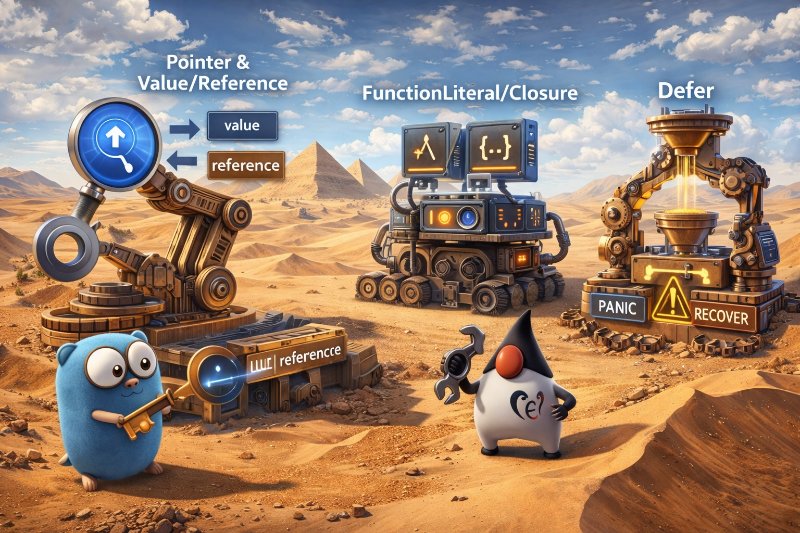
Pointers, functions, and execution control in Go vs Java | Types - Language
Series: Go for Java Developers — analyzing pointer, closures, defer, panic/recover In this article, we will analyze how Go manages the state and lifecycle of functions. A feature of Go is the ease of working with pointers without complex arithmetic, powerful closures, and built-in mechanisms for sa...
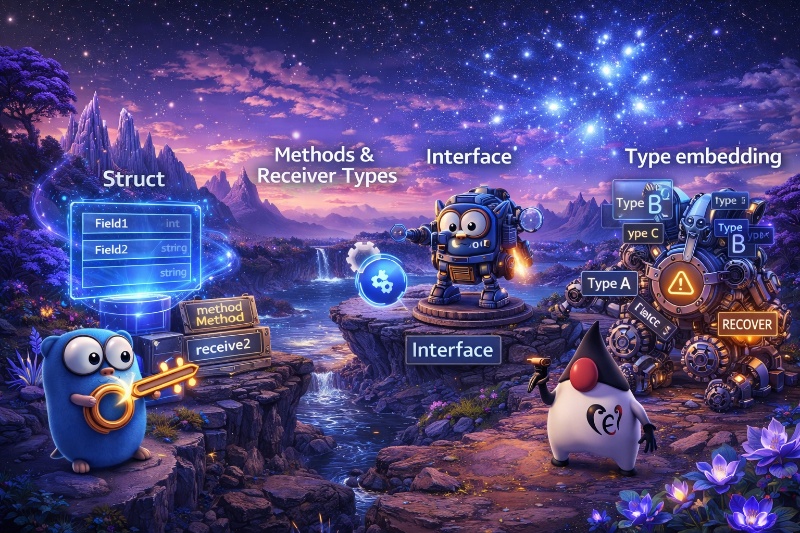
Struct, methods and interfaces in Go vs Java | Types - Language
Series: Go for Java Developers — exploring struct, interface, receiver types and type embedding In this article, we will examine how types architecture is built in Go. For a Java developer, this is especially important, as Go does not use classes in the conventional sense, and types and methods are...
Useful Articles:

Introduction Architecture is more than just a way to arrange classes and modules. It is the language a system uses to communicate time. Today, Java developers live in a world where the boundaries bet...
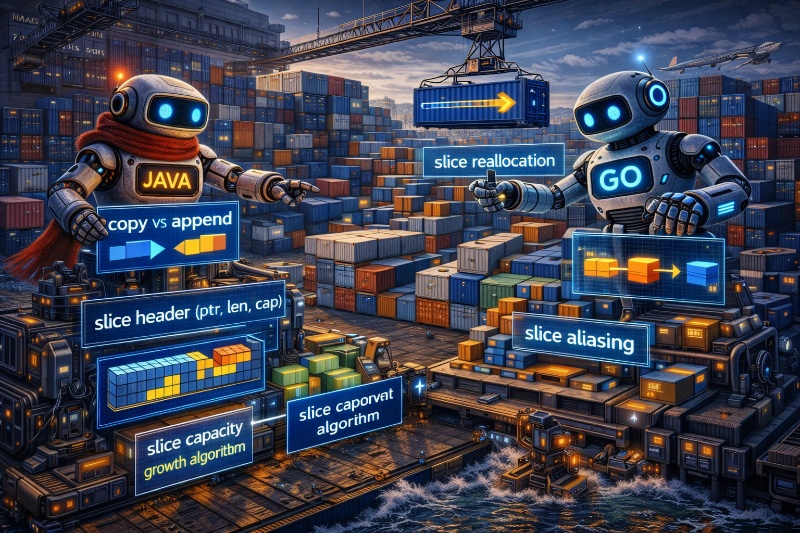
Slice in Go is one of those structures that looks simple, but under the hood behaves like a little clever beast. If you are a Java developer, you might think: "well, this is just an ArrayList." And th...

Introduction The Java world is rapidly evolving, and with each version, new tools are emerging for effectively working with multithreading, collections, and asynchrony. Java 25 brings powerful feature...
New Articles:
Concurrency is not about “starting many threads”. It’s about agreements between them. Imagine a restaurant kitchen: — cooks (threads / goroutines) — orders (tasks) — and the main question: how do th...

Imagine a typical production service. 32 CPU hundreds of threads configuration / session / rate limits cache tens of thousands of operations per second And somewhere inside — a regular Map. At first...

Zero Allocation — is an approach to writing code in which no unnecessary objects are created in heap memory during runtime. The main idea: fewer objects → less GC → higher stability and performance. ...