Concurrency
Multithreading in Go and Java: types of tasks and solution patterns
Multithreading is not just about "starting a million threads and letting them calculate". It is the art of efficiently using CPU and memory resources, safely processing data, and properly distributing tasks. In Go and Java, multithreading is used for different purposes: speeding up computations, w...
Useful Articles:

In this article, we will examine the key low-level mechanisms of Go, comparing them to similar tools in Java. The article is intended for Java developers who want to gain a deeper understanding of Go,...
Multithreading is not just about "starting a million threads and letting them calculate". It is the art of efficiently using CPU and memory resources, safely processing data, and properly distributing...
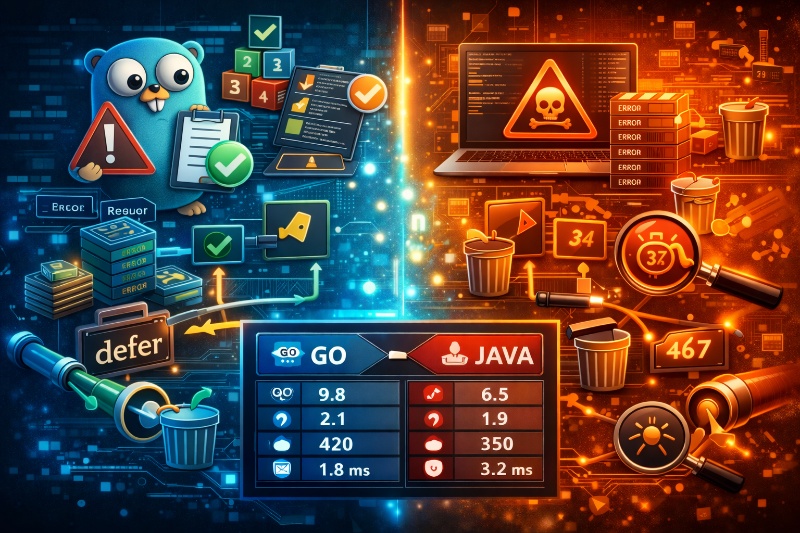
Error handling in Go is significantly different from the familiar Java approach with exceptions. Instead of try/catch, Go uses returning an error as a separate value, and `defer` helps safely release ...
New Articles:
Concurrency is not about “starting many threads”. It’s about agreements between them. Imagine a restaurant kitchen: — cooks (threads / goroutines) — orders (tasks) — and the main question: how do th...

Imagine a typical production service. 32 CPU hundreds of threads configuration / session / rate limits cache tens of thousands of operations per second And somewhere inside — a regular Map. At first...

Zero Allocation — is an approach to writing code in which no unnecessary objects are created in heap memory during runtime. The main idea: fewer objects → less GC → higher stability and performance. ...