Memory / Runtime / Allocator - Go vs Java
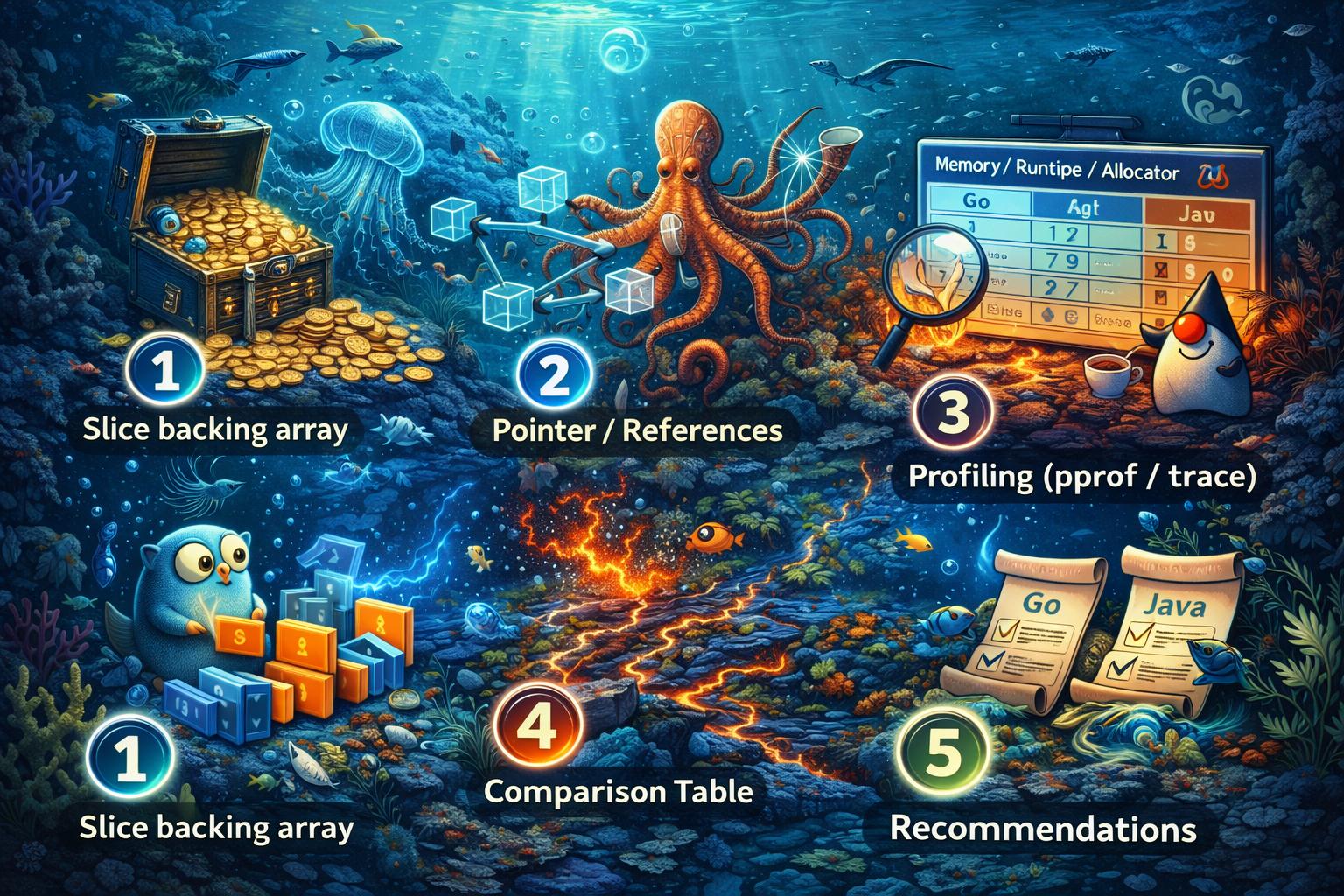
Memory management, pointers, and profiling are fundamental aspects of efficient code. Let's consider three key concepts: slice backing array, pointer, and profiling (pprof / trace), and compare Go with Java.
1. Slice backing array
A slice in Go is a lightweight structure over an array: it holds a pointer to the array, length, and capacity.
arr := [5]int{1,2,3,4,5}
s := arr[1:4]      // {2,3,4}, holds a reference to arr
s[0] = 20
fmt.Println(arr)   // [1,20,3,4,5]
Tip: if you change elements of a slice, remember that it changes the backing array and can unexpectedly affect other slices.
“A slice in Go is not just an array, but a tool for safe memory handling that allows sharing and extending data without copying”
The Java equivalent is ArrayList or an array, but copying a slice does not change the original:
int[] backingArray = new int[]{1,2,3,4,5};
int[] slice = Arrays.copyOfRange(backingArray, 1, 4);
slice[0] = 20;
System.out.println(Arrays.toString(backingArray)); // [1,2,3,4,5]
2. Pointer / References
Go allows using pointers directly:
x := 10
p := &x
*p = 20
fmt.Println(x) // 20
Tip: pointer arithmetic in Go is dangerous—use it only where absolutely necessary. In most cases, slices and structs are sufficient.
In Java, all objects are passed by reference, while primitives are passed by value. Example:
Integer x = 10;
Integer y = x; // copy of the reference
// Changing an immutable object is not possible, but array or List objects can be modified via reference
3. Profiling (pprof / trace)
Go has built-in tools for CPU and memory profiling:
import _ "net/http/pprof"
go http.ListenAndServe(":6060", nil)
Java uses JFR, VisualVM, Mission Control:
// java -XX:+UnlockCommercialFeatures -XX:+FlightRecorder -jar app.jar
Tip: always enable profiling during development or staging to see real memory and CPU issues.
4. Summary Comparison Table
| Feature | Go | Java |
|---|---|---|
| Slice / ArrayList | Slice holds a reference to the array, len, cap | ArrayList holds an internal array, copies do not change the original |
| Pointer / Reference | Can be modified directly | References to objects, primitives by value |
| Profiling | pprof / trace | JFR, VisualVM, Mission Control |
| Memory safety | Garbage collector + unsafe capabilities | GC + type safety |
5. Conclusion and Recommendations
- For Go: pay close attention to slices and pointers, profile with pprof.
- For Java: use references and built-in collections, profiling through JFR/VisualVM.
- General principles: understanding runtime, allocator, and reference model helps write efficient code and avoid unexpected side effects.
“Knowing how slices, pointers, and garbage collection work is critical to building high-performance and safe applications. In Go and Java, the approaches are different, but the concept of memory management and profiling is the same”
Оставить комментарий


Useful Articles:

New Articles: