💻 Programming and Technology Blog:
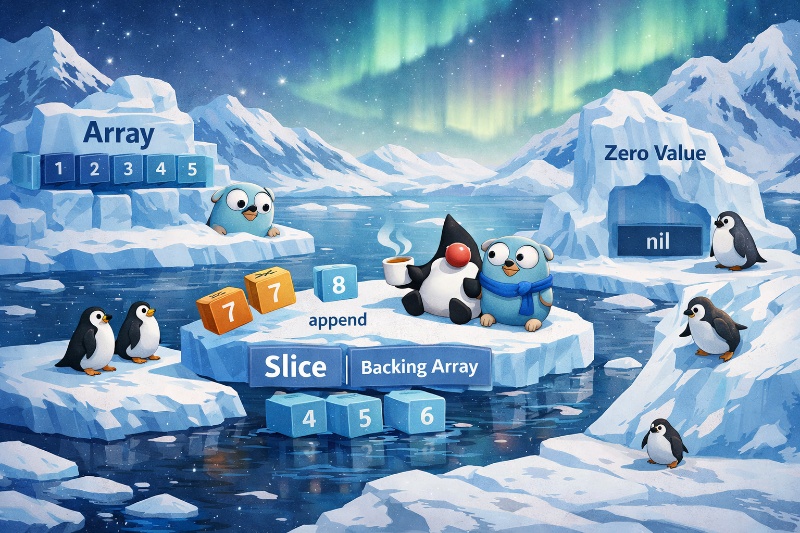
Analyzing: array, slice, map, zero value - in Go vs Java | Types - Language
Series: Go for Java Developers This article opens a series of materials about the Go language for developers who are already well acquainted with Java. We will compare the approaches of the two languages to quickly understand how the Go data model is structured and why it looks the way it does. Wh...
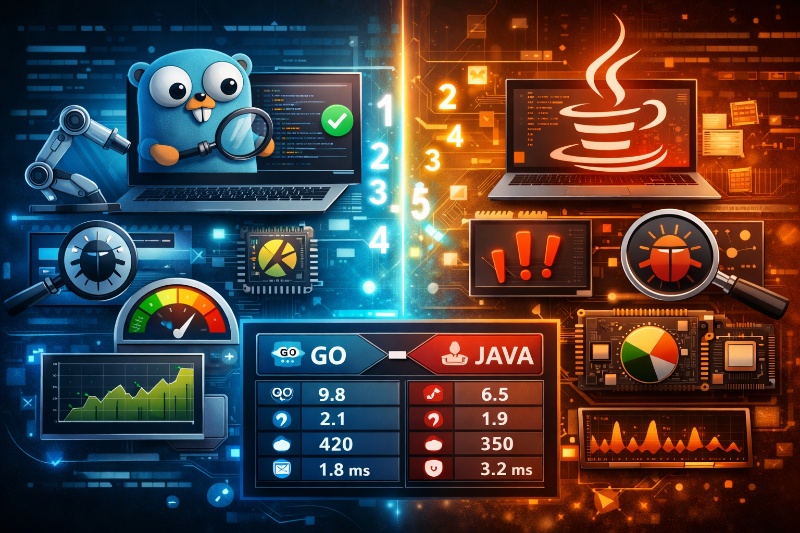
Analysis of Unit testing, Race detector, Benchmarking, Profiling (pprof) Go vs Java | Testing, Debugging, and Profiling
1. Unit testing In Go, the built-in package testing allows writing unit tests. For Java developers, this is analogous to JUnit/TestNG. Unit tests in Go are simple and built into the standard library. For Java, it is more common to use JUnit or TestNG. 2. Race detector Go has a built-in -race ...
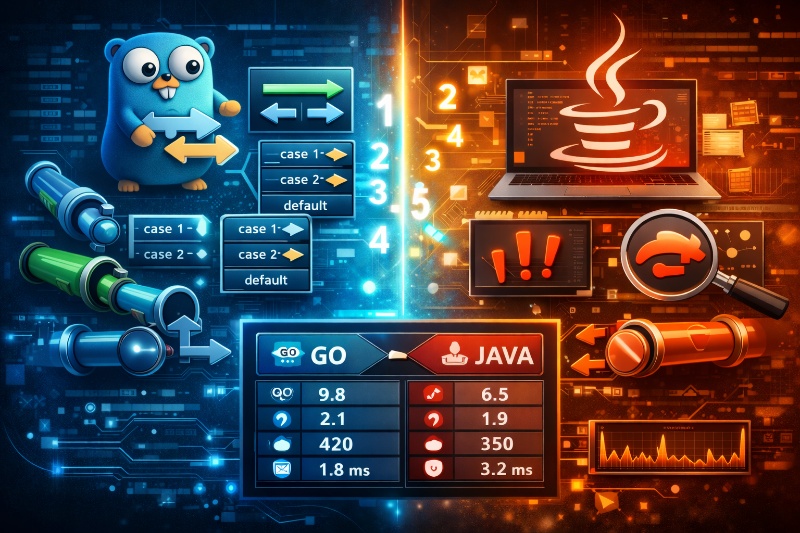
Channel direction and select patterns in Go vs Java | Patterns, idioms, and best practices in Go
← Related articles: Context, propagation and cancellation patterns in Go vs Java | Patterns, idioms and best practices in Go 1. Channel direction — channel directions In Go, channels can be one-way: only for sending or receiving. This helps to make function interfaces more safe and clear. For a...
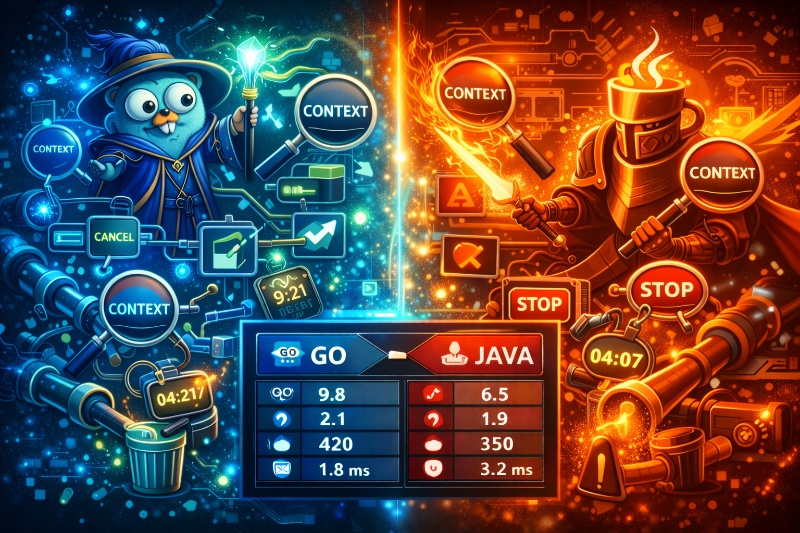
Context, propagation, and cancellation patterns in Go vs Java | Patterns, idioms, and best practices of Go
← Related articles: Part 1 — Error handling and defer in Go (Concurrency and synchronization) | Patterns, idioms and best practices for Go 1. Context and its role In Go context.Context is used to pass cancellation signals and timeouts between goroutine, as well as to pass values (propagation). ...
Error handling and defer in Go (Concurrency and synchronization) | Patterns, idioms, and best practices in Go
Error handling in Go is significantly different from the familiar Java approach with exceptions. Instead of try/catch, Go uses returning an error as a separate value, and `defer` helps safely release resources regardless of whether an error occurred or not. 1. Error handling idioms Error handling ...
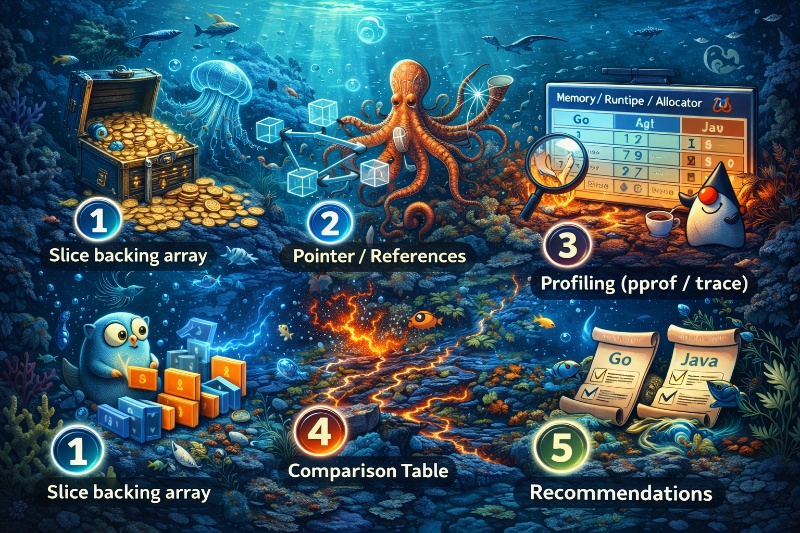
Memory / Runtime / Allocator - Go vs Java
Memory management, pointers, and profiling are fundamental aspects of efficient code. Let s consider three key concepts: slice backing array, pointer, and profiling (pprof / trace), and compare Go with Java. 1. Slice backing array A slice in Go is a lightweight structure over an array: it holds a po...
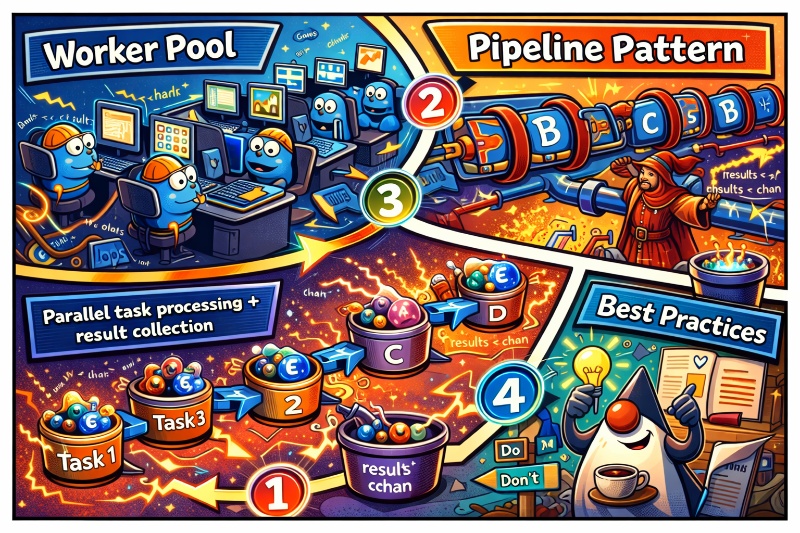
Practical patterns and optimization in Go vs Java | Concurrency part 3
← Part 2 — Synchronization and Safety in Go In this part, we will discuss practical patterns for parallel task processing: worker pool, pipeline pattern, and result assembly schemes. These patterns help improve performance and avoid deadlocks. Worker Pool Worker Pool - Worker Pool 🤲⚙️ a lim...

Synchronization and security in Go vs Java | Concurrency part 2
← Part 1 — Basics of Concurrency in Go for Java Developers In the second part, we will dive into synchronization and safety of concurrent code in Go. For a Java developer, it is useful to see the analogs: synchronized, ReentrantLock, CountDownLatch, atomic operations, and threading schemes. W...

Основы параллельности в Go для Java-разработчиков | Сoncurrency часть 1
Если вы Java-разработчик, привыкший к потокам и ExecutorService, Go предлагает более лёгкий и удобный подход к параллельной обработке — goroutine и каналы. В этой статье мы разберём ключевые концепции Go concurrency и сравним их с Java-аналогами. 1. Goroutine vs Thread Goroutine — это лёгкая единица...
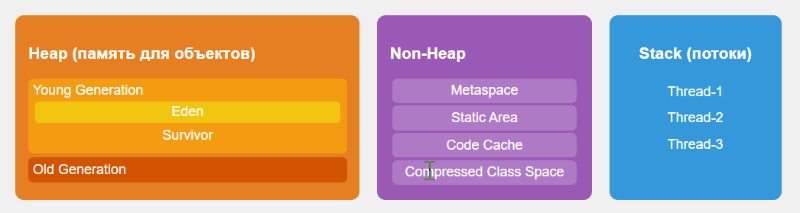
Java under the Microscope: Stack, Heap, and GC using Code Examples
Diagram - Java Memory Model - Heap / Non-Heap / Stack Heap (memory for objects) Creates objects via new. Young Generation: Eden + Survivor. Old Generation: objects that have survived several GC collections. Heap size is usually larger than Non-Heap. Young Generation Eden Survivor Old G...
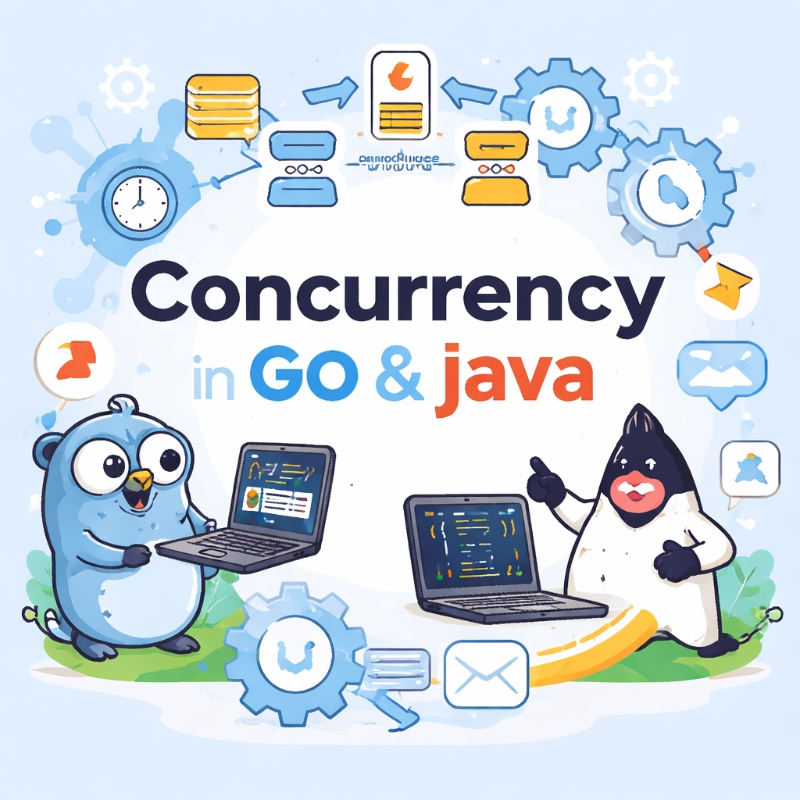
Multithreading in Go and Java: types of tasks and solution patterns
Multithreading is not just about "starting a million threads and letting them calculate". It is the art of efficiently using CPU and memory resources, safely processing data, and properly distributing tasks. In Go and Java, multithreading is used for different purposes: speeding up computations, w...
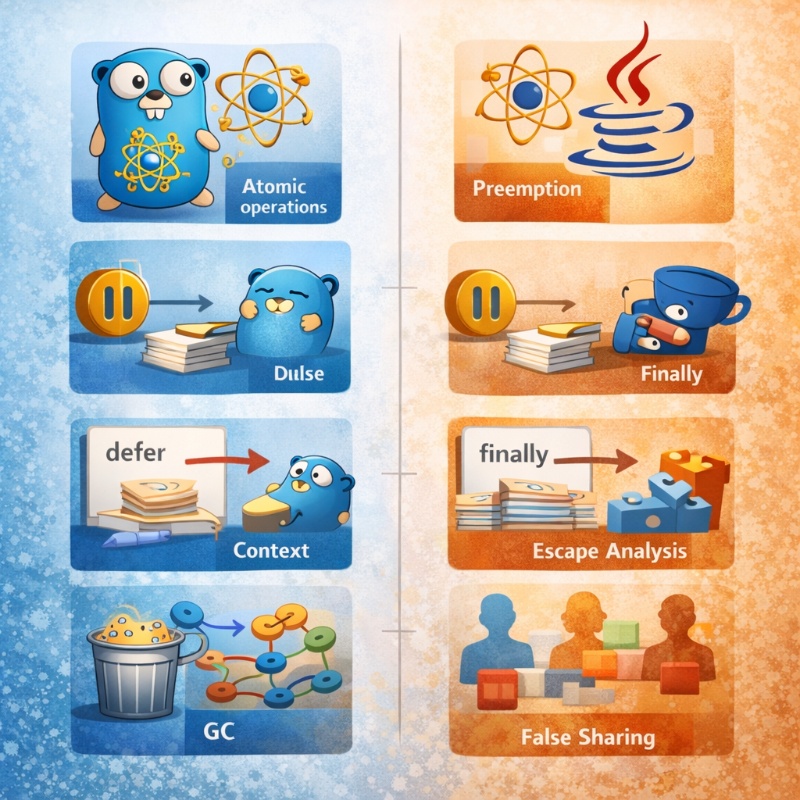
Go vs. Java - Comparing Memory Models - Part 2: Atomic Operations, Preemption, Defer/Finally, Context, Escape Analysis, GC, False Sharing
Atomic operations Atomic operations ensure correct execution of variable operations without race conditions, guaranteeing a happens-before between reads and writes. Go example: import "sync/atomic" var counter int32 func increment() { atomic.AddInt32(&counter, 1) // atomic increment } Java examp...
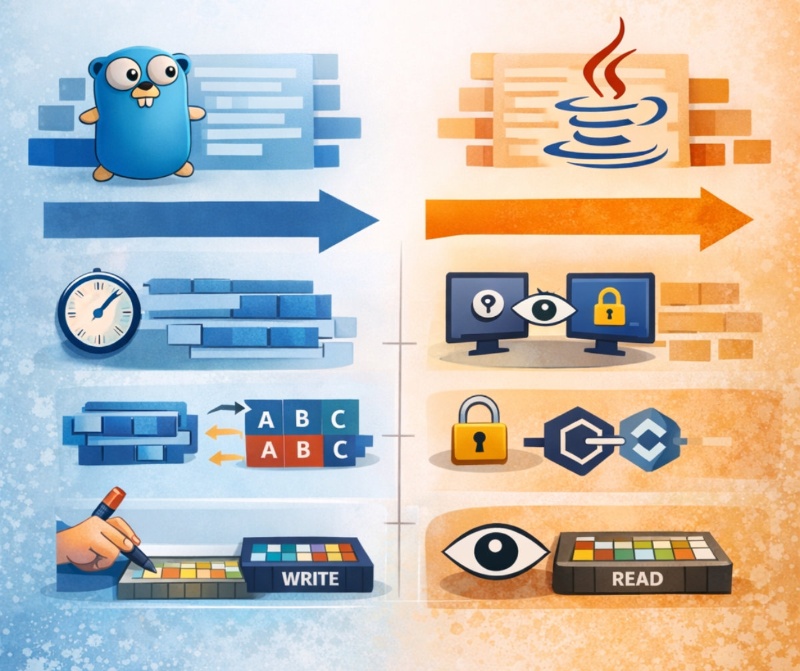
Go vs Java - comparison of memory models: happens-before, visibility, reorder, synchronization events, write/read barriers
Memory model is a layer between the program and the processor. Modern CPUs aggressively optimize execution: instructions may be reordered, data may be stored in core caches, and operations may be performed speculatively. Without strict rules, two threads could see completely different values of the ...

How to keep a legacy project from dying and give it another 10 years
Signs of a legacy project: how to recognize an old ship A legacy is not just old code. It is a living organism that has survived dozens of changes, team shifts, outdated technologies, and numerous temporary workarounds. It relies on the enthusiasm of engineers, the magical knowledge of "veterans," a...

Asynchrony and Reactivity in Java: CompletableFuture, Flow, and Virtual Threads
In modern Java development, there are three main approaches to asynchrony and concurrency: CompletableFuture — for single asynchronous tasks. Flow / Reactive Streams — for data flows with backpressure. Virtual Threads / Loom — for scalable, lock-free concurrency. Figurative Understanding Flow i...

Asynchrony in Java: Future, CompletableFuture, and Structured Concurrency
Java was originally designed for multithreading and parallel computing. Over time, various methods for working with the results of asynchronous tasks have emerged—from the classic Future to modern Structured Concurrency. Let s look at the main mechanisms, their pros and cons, and when to use them. 1...

Understanding multithreading in Java through collections and atomics
Understanding Multithreading in Java through Collections and Atomics 1️⃣ HashMap / TreeMap / TreeSet (not thread-safe) HashMap: Structure: array of buckets + linked lists / trees (for collisions). Under the hood: on put/remove, the array of buckets is modified and, possibly, the chains are reorder...

From the microservice revolution to the age of efficiency
The period from 2010 to 2020 can be called an era of separation and scaling. Systems have become too large to remain monoliths. The solution has been microservices — small autonomous applications that are deployed independently. They allowed teams to work in parallel and systems to scale horizontall...
Is it possible to know everything? The limits of mastery in a world of endless technologies
Reflection on why the completeness of knowledge is unattainable and how to build a personal architecture of professional growth. Every developer has at least once thought: “How to keep up with everything?” Technologies grow faster than the list of books in bookmarks. This is not a failure — it ...

Modern architectural approaches: from monolith to event-driven systems
Introduction Architecture is more than just a way to arrange classes and modules. It is the language a system uses to communicate time. Today, Java developers live in a world where the boundaries between services, data flows, and events are becoming increasingly thin. "A good architecture doesn t...
Useful Articles:
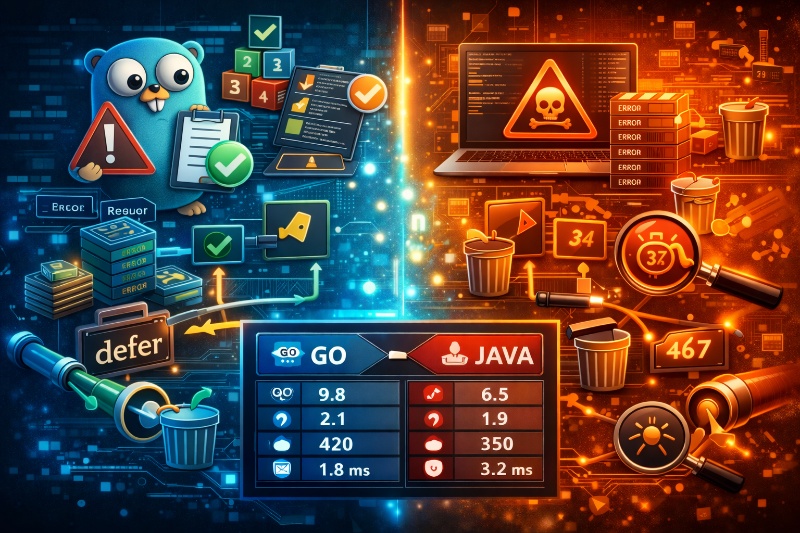
Error handling in Go is significantly different from the familiar Java approach with exceptions. Instead of try/catch, Go uses returning an error as a separate value, and `defer` helps safely release ...

In Java, performance is often determined not by the "beauty of the code," but by how it interacts with memory, the JIT compiler, and CPU cache. Let s analyze why the usual for is often faster than Str...
Hello! This is Vitaly Lesnykh. Today we will continue the course “Java Basics for Beginners” and discuss one of the most important topics in programming — loops. A loop is the repetition of code exe...
New Articles:
Concurrency is not about “starting many threads”. It’s about agreements between them. Imagine a restaurant kitchen: — cooks (threads / goroutines) — orders (tasks) — and the main question: how do th...

Imagine a typical production service. 32 CPU hundreds of threads configuration / session / rate limits cache tens of thousands of operations per second And somewhere inside — a regular Map. At first...

Zero Allocation — is an approach to writing code in which no unnecessary objects are created in heap memory during runtime. The main idea: fewer objects → less GC → higher stability and performance. ...